Tag: cell phone repair

  • Phone Speaker Not Working on Calls but Works on Music: Solution

    Phone Speaker Not Working on Calls but Works on Music: Solution

    When a phone speaker works perfectly for music, videos, and ringtones but stays silent during calls, it creates confusion for users and fresher technicians alike. Many people immediately assume hardware failure. In reality, this problem is often linked to settings, software conflicts, call audio routing, or partial speaker faults rather than a fully dead component.

    This detailed guide explains why call audio fails while media audio works, how to diagnose the exact cause, and what solutions actually work—from simple user-level checks to technician-grade repair steps for Android devices, iPhones, and other smartphones.

    “In phone repair, the fastest fix comes from understanding how audio paths are separated inside a device.”


    Understanding How Call Audio and Music Audio Are Different

    Before fixing the issue, it is important to understand how smartphones handle sound.

    Most modern mobile phones use different audio paths for different functions:

    • Music, videos, alarms, and ringtones usually play through the ringer (loudspeaker / bottom speaker).
    • Voice calls normally use the earpiece speaker (receiver / top speaker).
    • Speakerphone calls switch audio back to the loudspeaker.
    • Bluetooth and wired headsets override internal speakers completely.

    This separation means one speaker can work while the other fails, or software can block only call audio.


    Common Signs of This Problem

    You may be facing this issue if:

    • Music, YouTube, and WhatsApp voice notes play clearly
    • Incoming calls connect, but no sound from the top speaker
    • Speakerphone works, but normal call mode does not
    • Headphones work fine during calls
    • The other person can hear you, but you cannot hear them

    These symptoms strongly point toward earpiece speaker or call audio routing problems.


    Main Reasons Why Call Speaker Is Not Working

    1. Earpiece (Receiver) Speaker Fault

    The most common hardware cause is a damaged earpiece speaker, also known as:

    • Receiver
    • Call speaker
    • In-call speaker
    • Top speaker
    • Voice speaker

    Unlike the loudspeaker, the earpiece is small and delicate. It can fail due to:

    • Dust and sweat buildup
    • Moisture exposure
    • Drop impact
    • Wear after long-term usage

    Key clue: Speakerphone works, but normal call audio does not.


    2. Blocked or Dirty Earpiece Mesh

    Even if the receiver is electrically fine, blocked sound output can make it appear dead.

    Common causes include:

    • Pocket dust
    • Ear wax
    • Makeup residue
    • Screen protector covering the grill

    Many phones are “repaired” simply by cleaning the earpiece mesh properly.


    3. Call Audio Routed to Bluetooth

    Phones automatically route call sound to Bluetooth when:

    • Wireless earbuds were recently connected
    • Car audio was paired earlier
    • Bluetooth did not disconnect correctly

    Result: Call audio plays nowhere unless Bluetooth reconnects.


    4. Incorrect Sound or Accessibility Settings

    System-level settings can mute call audio without affecting music.

    Common problem settings:

    • Call volume set to zero
    • Mono audio conflicts
    • Hearing aid compatibility glitches
    • Accessibility audio balance shifted left or right

    These settings are often overlooked.


    5. Proximity Sensor Malfunction

    The proximity sensor controls screen behavior during calls. If it fails:

    • Screen stays black
    • Touch becomes unresponsive
    • Call audio may mute unexpectedly

    This creates the false impression of a speaker problem.


    6. Software Bug or Corrupted Audio Driver

    Software-related call audio issues are more common after:

    • System updates
    • Custom ROM installation
    • App conflicts
    • Failed firmware upgrades

    In such cases, music audio remains unaffected, while call audio fails.


    7. Audio IC or Motherboard Fault (Advanced)

    If both earpiece and software checks fail, the issue may lie in:

    • Audio codec IC
    • Call audio line from CPU
    • Broken solder joints
    • Liquid damage to audio section

    This is less common but critical for technicians to consider.


    Step-by-Step Solutions for Users (Non-Technical)

    Step 1: Increase Call Volume Properly

    During an active call:

    1. Press the volume up key
    2. Ensure call volume is not muted
    3. Do not rely on media volume

    Call and media volumes are separate controls.


    Step 2: Turn Off Bluetooth Completely

    1. Disable Bluetooth
    2. Restart the phone
    3. Make a test call

    Many call audio issues disappear after this simple step.


    Step 3: Test Speakerphone Mode

    • Make a call
    • Enable speakerphone

    If audio is clear on speakerphone, the earpiece speaker is likely faulty or blocked. Also try restarting the phone before cleaning the receiver (Next Step).


    Step 4: Clean the Earpiece Grill Safely

    Use:

    • Soft brush
    • Toothpick (gently)
    • Isopropyl alcohol (minimal)

    Avoid pins or sharp metal tools.

    Never apply liquid directly into the grill.


    Step 5: Check Safe Mode (Android)

    Safe Mode disables third-party apps.

    • If call audio works in Safe Mode
    • The issue is likely caused by an app conflict

    Uninstall recently added audio, call, or recording apps.


    Step 6: Reset Sound Settings (Without Data Loss)

    Many smartphones allow resetting system settings only.

    This fixes:

    • Corrupted audio profiles
    • Accessibility conflicts
    • Call routing errors

    Technician-Level Diagnosis and Repair Guide

    This section is for mobile repair technicians, students, and advanced learners.


    Step 1: Confirm Speaker Type Involved

    Use this logic:

    • Music works → Loudspeaker OK
    • Speakerphone works → Loudspeaker OK
    • Headphones work → Audio codec partially OK
    • Normal call silent → Receiver path issue

    This narrows diagnosis quickly.


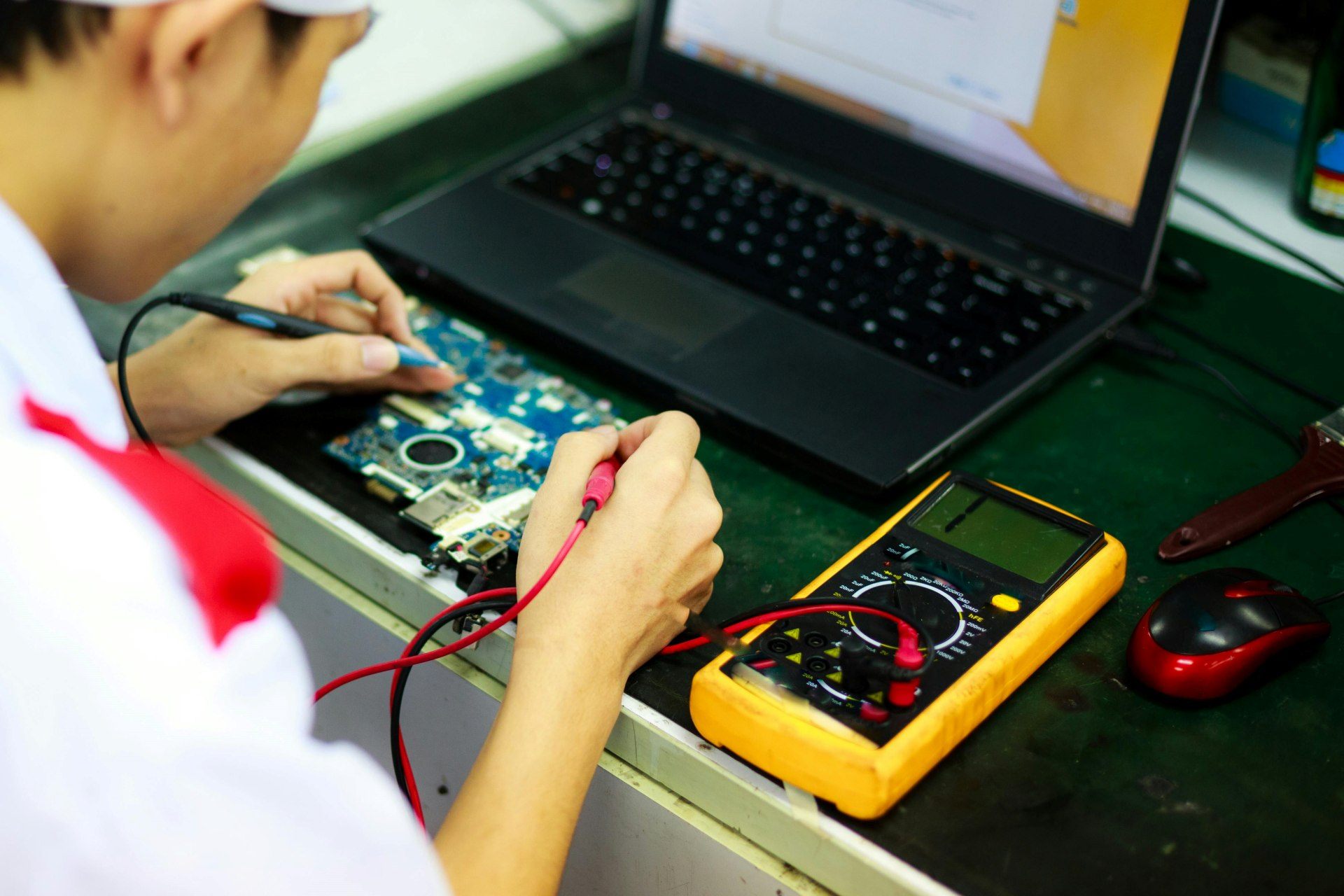
    Step 2: Test Earpiece Speaker Using Multimeter

    • Measure resistance across earpiece terminals
    • Typical value: 25–60 ohms (varies by model)
    • Open circuit = faulty receiver

    Learn how to test ear speaker (receiver) with a multimeter. Replace with a known-good speaker for confirmation.


    Step 3: Inspect Earpiece Connector and Flex

    Check for:

    • Loose contact
    • Oxidation
    • Bent pins
    • Torn flex cable

    On many phones, the receiver connects via:

    • Front flex
    • Screen assembly
    • Dedicated earpiece board

    Step 4: Swap with Known Working Part

    The fastest professional test is part substitution.

    • Replace earpiece
    • Test call audio
    • Confirm before full reassembly

    This avoids unnecessary motherboard work.


    Step 5: Check Proximity Sensor Function

    Dial test codes or use diagnostic menus.

    If the proximity sensor:

    • Stays triggered constantly
    • Does not respond to hand movement

    Fix or replace sensor before audio IC suspicion.


    Step 6: Software Flash or Firmware Restore

    If hardware tests pass:

    • Backup data
    • Flash stock firmware
    • Avoid third-party ROMs during diagnosis

    Software corruption often mimics hardware failure.


    Step 7: Audio IC and Board-Level Inspection

    Only if all above steps fail:

    • Inspect audio IC area
    • Check for liquid damage
    • Measure call audio line continuity
    • Reball or replace IC if needed

    This step requires proper tools and experience.

    “Good technicians replace parts. Great technicians replace only what is proven faulty.”


    iPhone-Specific Call Speaker Issues

    On iPhones, this problem often relates to:

    • Face ID flex damage
    • Earpiece mesh blockage
    • Proximity sensor failure
    • Water damage near top assembly

    Important note: On many iPhone models, the earpiece speaker is linked to Face ID components. Incorrect replacement can disable Face ID permanently.

    Always follow model-specific procedures.


    Android-Specific Observations

    On Android phones:

    • Audio routing bugs are more common
    • Custom UI updates may affect call sound
    • Low-quality replacement earpieces cause distortion

    Use original-quality parts whenever possible.


    When Replacement Is Necessary (And When It Is Not)

    Replace the earpiece speaker if:

    • No sound in normal calls
    • Speakerphone works
    • Resistance reading is abnormal
    • Cleaning does not help

    Do not replace immediately if:

    • Bluetooth is active
    • Call volume is muted
    • Safe Mode restores sound
    • Software reset fixes issue

    Balanced judgment saves time and money.


    Preventive Tips for Long-Term Reliability

    • Keep earpiece area clean
    • Avoid phone calls with wet ears
    • Do not blow air forcefully into speaker grills
    • Use quality screen protectors with proper cutouts

    Small habits reduce speaker failures significantly.


    Frequently Asked Questions (Quick Answers)

    Can receiver problem be fixed without opening the phone?
    Yes. Many cases are caused by settings, Bluetooth, or dirt.

    Is speaker issue a motherboard problem?
    Rarely. Most cases involve the receiver or software.

    Why does WhatsApp audio work but calls do not?
    Different apps may route audio differently.

    Does factory reset always fix receiver problem?
    Only if the issue is software-related.


    Final Thoughts

    When a phone speaker does not work during calls but plays music clearly, the issue is rarely mysterious. It is usually a receiver speaker fault, blocked sound path, audio routing error, or software glitch.

    For users, simple checks often restore sound within minutes. For technicians, structured diagnosis prevents unnecessary part replacement and builds professional credibility.

    “Understanding signal flow is more powerful than replacing parts blindly.”

    If you approach this problem step by step, you will not only fix it faster—but fix it right.

  • Mobile Phone Repair Technician Resume Sample (Free Download)

    Mobile Phone Repair Technician Resume Sample (Free Download)

    Finding a job as a mobile phone repair technician becomes much easier when you have a clear and professional resume. Many skilled technicians struggle with job applications not because they lack skills, but because their resume, CV, or bio-data is poorly written or confusing.

    A good resume does not need big English words or complicated formats. It only needs to clearly show what you can repair, what experience you have, and how an employer can contact you. Whether you are a fresher learning mobile repair or an experienced technician handling Android phones and iPhones daily, a simple and correct resume makes a strong first impression.

    “Skills open the door, but a good resume helps you walk through it.”

    This guide explains how to create a mobile phone repair technician resume, also known as a CV (Curriculum Vitae) or bio-data, and provides ready-to-use editable samples you can download and modify.


    What Is Inside a Mobile Phone Repair Technician Resume?

    A mobile repair technician resume is a short document that explains:

    • Your repair skills
    • Your work experience
    • The type of phones and devices you can handle
    • Your contact details

    In different countries, the same document may be called:

    • Resume
    • CV (Curriculum Vitae)
    • Bio-data
    • Job profile
    • Technician profile

    All these terms mean the same thing in practical job applications.


    Why a Simple Resume Works Best for Technicians

    Many technicians think a resume must look fancy. This is not true.

    Workshop owners, service centers, and mobile repair shops look for:

    • Clear skills
    • Honest experience
    • Practical knowledge
    • Easy-to-read information

    A simple resume gets more callbacks than a complicated one.


    Important Sections Every Technician Resume Must Have

    No matter your experience level, your resume should include only these essential sections.

    1. Personal Details

    • Name
    • Mobile number
    • Email (if available)
    • City or area

    Keep this short and clear.


    2. Career Objective or Summary

    This is 1–2 lines about your goal.

    Example:

    • To work as a mobile phone repair technician and grow my technical skills.

    Avoid long paragraphs.


    3. Technical Skills (Most Important Section)

    This is what employers read first.

    Mention skills such as:

    • Android phone repair
    • iPhone repair
    • Battery replacement
    • Charging problem repair
    • LCD screen replacement
    • Software flashing
    • Fault diagnosis

    Always write only what you can actually do.


    4. Work Experience

    If you have experience, mention:

    • Number of years
    • Type of shop or service center
    • Devices handled (Tablets, iPhones, Android phones)

    If you are a fresher, write:

    • Trainee or fresher
    • Practical training experience

    5. Education or Training

    This can be simple:

    • School education
    • Mobile phone repairing course
    • ITI or short-term training

    Education level is less important than repair skills in this field.


    Resume Tips from Real Repair Experience

    • Do not write false experience
    • Do not use copied online resumes
    • Keep resume to one page
    • Avoid spelling mistakes
    • Use simple language

    “Honest skills last longer than fake experience.”


    Resume Format for Different Experience Levels

    To make it easy, below are three ready resume formats based on skill level.

    1. Basic Resume (For Freshers)

    Best for:

    • Freshers
    • New learners
    • Trainees

    Focus:

    • Basic repair skills
    • Willingness to learn

    2. Intermediate Resume (1–3 Years Experience)

    Best for:

    • Shop technicians
    • Service center helpers

    Focus:

    • Repair skills
    • Daily repair work
    • Software and hardware skills

    3. Advanced Resume (Experienced Technicians)

    Best for:

    • Senior technicians
    • Board-level repair workers

    Focus:

    • Hardware and software repair skills
    • IC work
    • Advanced fault diagnosis
    sample simple and basic resume bio-data format for entry level technicians. imae credit to shine.com

    Free Download: Editable Resume Samples (MS Word)

    You can download and edit these resumes easily on mobile or computer.

    📄 Resume Downloads

    • 👉 Basic Mobile Repair Technician Resume (MS-Word)
      Download
    • 👉 Intermediate Mobile Repair Technician Resume (MS-Word)
      Download
    • 👉 Advanced Mobile Repair Technician Resume (MS-Word)
      Download

    These files are:

    • Editable in MS Word
    • Simple and clean
    • Suitable for job applications
    • Easy to understand for technicians

    Resume vs CV vs Bio-Data: Which One Should You Use?

    • Resume → Common in the United States and service centers
    • CV (Curriculum Vitae) → Common globally
    • Bio-data → Common in India and Gulf countries

    You can use the same format for all. Only the name changes.


    Common Resume Mistakes Technicians Should Avoid

    • Writing long stories
    • Adding unrelated jobs
    • Using difficult English
    • Mentioning skills you don’t know
    • Using decorative designs

    Clear information matters more than design.


    Who Can Use These Resume Samples?

    These resume formats are suitable for:

    • Mobile phone repair technicians
    • Smartphone service center staff
    • Android repair technicians
    • iPhone repair technicians
    • Freshers and experienced workers

    Free Apps to Create a Professional Resume

    If you do not have a computer, you can still prepare a professional resume, CV (Curriculum Vitae), or bio-data using free mobile apps. These apps are easy to use and suitable for mobile phone repair technicians, even if you are not highly educated.

    Below are trusted, free apps with official download links.


    1. Indeed Resume Builder (Free)

    Indeed offers a free resume builder inside its official job search app.

    Download links:

    Why technicians use it:

    • Very simple and clean resume format
    • Professional look
    • Good for freshers and basic technicians
    • Resume can be downloaded as PDF

    2. Resume Builder – CV Maker (Android)

    Several free resume apps are available on Android under this name.

    Download link (Android):

    Why it is useful:

    • Step-by-step resume filling
    • Easy bio-data style formats
    • No design or English expertise needed

    Best for Android users and entry-level technicians.


    Tip: Always choose simple and professional templates, not colorful ones.


    3. Microsoft Word Mobile (Free)

    Microsoft Word mobile app is best for editing resume or bio-data files.

    Download links:

    Why it is recommended:

    • Very simple and professional
    • Works perfectly with Word resume samples
    • Accepted by all employers

    4. Google Docs (Free)

    Google Docs also provides resume templates and easy editing.

    Download links:

    Why it is useful:

    • Completely free
    • Auto-save feature
    • Easy sharing with employers

    Final Thoughts

    A mobile phone repair technician does not need a complicated resume. What matters is clarity, honesty, and practical skills. A clean resume shows professionalism and helps employers trust your abilities even before meeting you.

    If you update your resume as your skills grow, it becomes a strong career tool.

  • How to Use SMD Rework Station for Mobile Repair (Guide)

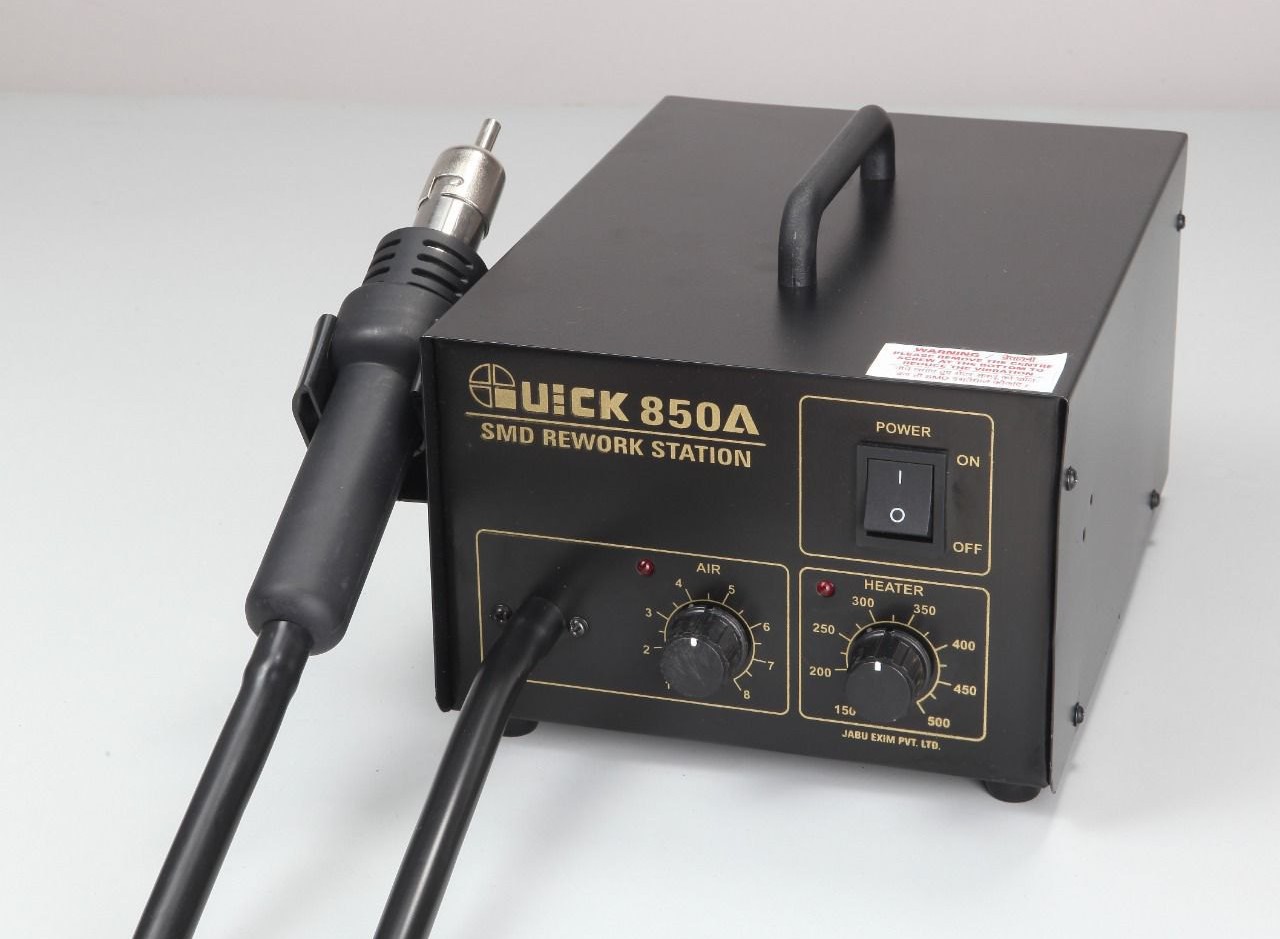
    How to Use SMD Rework Station for Mobile Repair (Guide)

    In the world of mobile phone repairing, the SMD rework station is one of the most essential and powerful tools. It allows technicians to heat, solder, remove, and reflow components with precision. Whether you want to repair a charging port, fix a loose IC, or carry out micro-level maintenance, this tool is the backbone of hardware repair work.

    Yet many beginners feel intimidated by it. They fear damaging nearby components, overheating ICs, or using the wrong settings. In reality, using a rework station is simple once you understand the fundamentals. It is a tool of accuracy, not force, and the more confidently you handle it, the better your repair results.

    As many experienced technicians say, “A rework station is only dangerous in untrained hands — in skilled hands, it’s a miracle machine.”

    This guide covers everything you need to know, from how the tool works to professional techniques you can start using immediately.


    What Is an SMD Rework Station?

    An SMD rework station (also called a hot air rework station, BGA rework station, or simply “blower” in repair shops) is a machine that blows out controlled hot air. This hot air allows you to:

    • Heat ICs
    • Remove ICs
    • Reflow solder joints
    • Fix dry solder faults
    • Replace SMD components
    • Install charging ports
    • Repair microphones, sensors, and connectors

    It provides precision heating, something a soldering iron cannot achieve on its own.

    Modern rework stations come with:

    • Temperature control
    • Airflow control
    • Different nozzle sizes
    • Anti-static safety measures
    • Heating element protection
    • Digital displays (in many models)
    • Infrared versions for highly sensitive components

    The goal is not to burn components, but to heat them safely and evenly until solder melts or reflows.


    Why Do ICs and Components Need Heating or Rework?

    Several real-world conditions cause ICs and SMD components to develop loose connections:

    • Vibrations
    • Sudden impacts or drops
    • Repeated heating and cooling cycles
    • Normal wear and tear
    • Moisture
    • Manufacturing limitations
    • Poor quality soldering
    • Excessive current load

    The result is a dry solder joint, meaning the solder balls or pads lose proper contact with the PCB.

    Depending on which component is affected, you may experience issues like:

    • Phone not switching ON
    • No charging
    • No network
    • No sound
    • Display not working
    • Auto restart
    • Heating issues
    • Touch not working
    • Camera errors

    This is especially common with BGA ICs, which have hundreds of tiny solder balls under them.

    Sometimes, simply heating the IC with the rework station reflows the dry joints and fixes the issue.

    If the problem remains, technicians proceed with:

    1. Reballing the IC (rare and advanced)
    2. Replacing the IC with a new one

    Different Types of Rework Stations

    While your original content mentions the traditional hot air station, today’s market includes several advanced types:

    1. Hot Air Rework Station (Most Common)

    • Uses controlled hot air
    • Works for most mobile repair jobs
    • Affordable and easy to learn

    2. Infrared Rework Station

    • Heats using infrared light
    • Does not burn plastic parts
    • Useful for sensitive components
    • More expensive but safer

    3. Hybrid Rework Station

    • Combines hot air + infrared
    • Excellent for BGA ICs
    • Used in professional repair labs

    For most mobile repair technicians and DIY learners, a standard hot air rework station is more than enough.


    Parts of the Rework Station You Must Understand

    A rework station has several core controls:

    • Temperature Control (Heat Control)

    Sets how hot the air will be.
    Higher temperatures melt solder faster, but can damage components if misused.

    • Airflow Control (Air Control)

    Regulates the force of air coming out.
    Too much airflow can blow components away.

    • Nozzles / Tips

    Direct the air to a precise area.
    Narrow nozzles: ICs and small jobs
    Wide nozzles: Larger components, heating areas

    • Heating Element

    Inside the handle, it heats the air.

    • Stand

    Holds the handle safely when not in use.

    Learning these parts makes operation safer and more accurate.


    Choosing the Correct Temperature

    A common question is:
    What temperature should I use?

    Your old content mentioned 300–400°C, which is still accurate — but technique matters more than raw numbers.

    General Temperature Guidelines

    • Small SMD components: 280–330°C
    • Medium-size ICs: 320–350°C
    • Large ICs or BGA chips: 350–400°C
    • Charging ports: 300–350°C
    • Plastics nearby: Use lower heat or shield them

    The actual temperature required depends on:

    • PCB thickness
    • IC size
    • Nozzle size
    • Type of solder
    • Position of nearby parts
    • Condition of the board

    Important:
    Never start with high heat. Begin low, then increase slowly.


    Choosing the Correct Airflow Setting

    Airflow is just as important as temperature.

    Too much air = components blown away
    Too little air = heating element gets damaged

    Recommended airflow:

    • Slightly above the minimum
    • Smooth, controlled flow
    • Enough to allow even heating

    For beginners, a low-to-medium airflow gives the best results.


    Selecting the Right Nozzle

    Different tasks require different air concentration.

    Narrow nozzles

    • Use for ICs, SMD parts, connectors
    • Direct heat precisely
    • Reduce damage to nearby components

    Wide nozzles

    • Use for removing shields
    • Heating large areas
    • Preheating boards

    Choosing the right nozzle prevents accidental damage.


    Using Soldering Flux: The Secret to Clean Work

    Flux is essential during heating and removal.

    Benefits of using flux:

    • Lowers melting temperature
    • Prevents oxidation
    • Allows solder to flow smoothly
    • Avoids pad lifting
    • Protects delicate joints

    Apply flux around the edges of the IC or part before heating.

    Without flux, your work will be harder and riskier.


    How to Use the Rework Station Step-by-Step (Beginner-Friendly)

    Now let’s convert everything into a practical, easy-to-follow process.


    Step 1: Prepare the Work Area

    • Use a clean, flat surface
    • Make sure lighting is bright
    • Keep tools organized
    • Wear anti-static precautions if possible

    Step 2: Apply Soldering Flux

    Apply a small amount around:

    • The IC
    • Charging port
    • Component you want to remove or heat

    Flux helps in reflow and removal.


    Step 3: Set Temperature and Airflow

    A safe starting point:

    • Heat: 320–350°C
    • Air: Slightly above minimum

    Adjust based on board response.


    Step 4: Start Heating in Circular Motion

    Do not hold the nozzle directly in one spot.
    Move the handle in small circular motions around the component.

    This ensures:

    • Even heating
    • No overheating of one area
    • Smooth solder melting

    Professionals say: “Your hand must dance, not stay still.”


    Step 5: Continue Heating Until the Component Loosens

    You will notice:

    • Solder becomes shiny
    • IC edges loosen
    • Component moves slightly with tweezers

    Do not pull or force removal.
    If it resists, heat a little more.

    For reflow (not removal), 2–3 rounds of slow circular heating are usually enough.


    Step 6: Lift the Component Carefully

    Use:

    • Fine tweezers
    • IC lifter
    • Straight motion

    Avoid twisting, as this may lift pads from the board.


    Step 7: Clean the Pads and Prepare for New Component

    Use:

    • Solder wick
    • Flux
    • Low-heat iron
    • IPA (isopropyl alcohol)

    Clean pads must be shiny and flat before replacing any component.


    When to Use Reflow, Reballing, or Replacement

    1. Reflow (Heating only)

    Use when:

    • IC connections are dry
    • Minor faults appear after drops
    • Device behaves intermittently

    Most common and safest method.


    2. Reballing

    Used rarely by technicians because:

    • Time-consuming
    • Requires specialized tools
    • Risky for beginners

    Performed only when:

    • IC is good
    • Solder balls are shorted or oxidized
    • No replacement IC available

    3. IC Replacement

    Use when:

    • IC is faulty
    • Component is burnt
    • Reflow does not fix the issue
    • Overheating persists
    • No power faults exist

    Replacing the IC is often the best solution for dead phones.


    Infrared Rework Stations: Modern Alternative

    Infrared stations are gaining popularity.

    Benefits:

    • No airflow = no component blowing
    • Safe for plastics
    • Very even heating
    • Ideal for sensitive ICs

    Drawback:

    • More expensive
    • Requires practice to control heat spread

    If you repair phone motherboards regularly, infrared is a great investment.


    Common Problems Beginners Face (and Solutions)

    1. Nearby parts melting or shifting

    • Reduce air
    • Change nozzle
    • Use aluminum tape to protect parts

    2. IC does not loosen

    • Increase temperature slightly
    • Allow more preheating
    • Apply more flux

    3. Pads lift from PCB

    • Too much heat
    • Holding heat too long
    • Pulling the component forcefully

    Solution: Practice on dead boards first.


    4. Board burns or turns black

    • Overheating
    • Air too low
    • No movement of nozzle

    Keep the nozzle moving at all times.


    5. Coil inside handle burns

    • Airflow too low
    • Blocked nozzle

    Always ensure airflow is slightly above minimum.


    Practical Real-Life Example

    A technician receives a phone that does not charge.
    Diagnosis:

    • Charging port loose
    • Connections cracked internally

    Solution:

    1. Apply flux
    2. Heat port with medium heat
    3. Remove port safely
    4. Clean pads
    5. Install new port with reflow + iron

    The phone charges perfectly after repair.

    This is a common situation solved easily with a rework station.


    Safety Tips You Should Always Follow

    • Never touch the nozzle during or after use
    • Use tweezers, not fingers
    • Keep flammable objects away
    • Do not point hot air at cables or battery
    • Let the machine cool before storing
    • Practice on dead boards before real repairs

    Safety comes first — mobile boards are small and sensitive.


    Conclusion

    Using an SMD rework station may seem complex, but once you understand heat control, airflow, nozzles, and flux, the process becomes smooth and almost artistic. It is one of the most important skills in mobile phone hardware repair, enabling you to fix ICs, connectors, charging ports, and countless other components with precision.

    Start with simple tasks, practice on dead boards, and gradually move to more advanced repairs. With patience and consistency, you’ll master the rework station and unlock a whole new level of repair expertise.

  • What Is Mobile Flashing? Step-by-Step Guide to Flash a Phone

    What Is Mobile Flashing? Step-by-Step Guide to Flash a Phone

    Mobile flashing is a term that many people hear, especially in repair shops or online forums, but it is often misunderstood. Some think it is only for fixing software problems, while others believe it’s a risky trick that can damage a device. The truth lies somewhere in between. Flashing is a powerful method used to reinstall or upgrade the phone’s system software, and when done correctly, it can bring a dead or slow phone back to life.

    This article breaks down everything in simple language — what flashing is, why people do it, how it works, how to perform it safely, and when you should avoid it. Along the way, you’ll also learn practical insights from real repair experiences to help you make confident decisions.


    Understanding Mobile Flashing in Simple Terms

    At its core, flashing means installing new software (firmware or OS) onto a mobile phone. Think of it as reinstalling Windows on a computer or restoring a factory image on a laptop.

    When you flash a device, you are replacing or refreshing its internal software. This includes:

    • Operating system
    • System apps
    • Bootloader files
    • Vendor-specific customizations

    Flashing can be done using official tools from phone brands or third-party tools used by experienced technicians.

    In simple words: Flashing is the process of rewriting your phone’s software to fix issues or install a new version.

    “Technology becomes clearer the moment we understand how it works.”


    Why Do People Flash Their Phones?

    Different users have different purposes. Some want to fix problems. Others want to upgrade or customize their phone. Technicians use flashing as a repair method.

    Here are the most common reasons:

    1. Fixing Software Issues

    Flashing can repair problems like:

    • Phone stuck on logo
    • Bootloop
    • Auto restart
    • System crashing
    • Apps not working properly
    • Virus infection
    • Software corruption after updates

    When normal factory reset fails, flashing is often the only solution.


    2. Updating the Operating System

    Sometimes devices do not get official updates. Flashing allows installing:

    • A newer Android version
    • Region-specific firmware
    • Stable versions replacing buggy updates

    This can improve performance and battery life.


    3. Removing Bloatware or Custom UI

    Advanced users sometimes flash custom ROMs to remove unwanted apps or heavy skins. This gives:

    • A clean interface
    • Better speed
    • More storage space

    However, custom ROMs require root access, which involves risks.


    4. Repairing Dead Phones

    Many “dead phones” caused by corrupted firmware are revived through flashing. Repair shops commonly use this method with specialized software boxes.


    5. Unlocking or Changing Region Settings

    Flashing can help when a device needs:

    • Carrier unlock (where legally permitted)
    • Conversion to a different region version
    • Language changes

    6. Improving Performance

    A fresh firmware installation can:

    • Reduce lag
    • Fix background process issues
    • Improve RAM management
    • Stabilize network performance

    “A phone with clean software runs longer than a phone with expensive hardware.”


    Types of Flashing

    Flashing isn’t the same for all phones. Every platform uses its own method.

    1. Stock Firmware Flashing

    This is the most common and safest method. You install the manufacturer’s official firmware.

    Examples:

    • Samsung Odin
    • Xiaomi Mi Flash Tool
    • Motorola RSD Lite
    • Vivo & Oppo Flash Tool

    This method keeps warranty intact if the firmware is official.


    2. Custom ROM Flashing

    This installs third-party firmware created by developers.

    Benefits:

    • Highly customizable
    • Cleaner interface
    • Better speed

    Risks:

    • Warranty void
    • Bugs or instability
    • Security issues

    This is for advanced users only.


    3. Flashing Through Recovery

    Some phones allow flashing using the recovery menu. You can install:

    • Update.zip packages
    • Custom ROMs
    • Patches
    • Mods

    4. Flashing Using a Professional Box or Dongle

    Technicians use tools like:

    • UMT
    • Miracle Box
    • MRT
    • Chimera Tool
    • Octopus

    These tools handle deep-level flashing, IMEI problems (where legally permitted), and FRP resets.


    What You Need Before Flashing a Phone

    Flashing requires preparation. Skipping these steps can cause data loss or errors.

    1. Correct Firmware File

    Always choose firmware based on:

    • Phone model number
    • Region
    • Build number
    • Chipset

    Wrong firmware can brick your phone.


    2. Flash Tool (Software)

    Examples:

    • Odin – Samsung
    • SP Flash Tool – MediaTek devices
    • QFIL – Qualcomm devices
    • Mi Flash Tool – Xiaomi

    Choose based on the chipset.


    3. USB Cable & Drivers

    Install the correct drivers:

    • ADB drivers
    • Fastboot drivers
    • OEM-specific drivers

    Without drivers, the system will not detect the device.


    4. Charged Battery

    Keep battery at least 50% charged to avoid sudden shutdown.


    5. Backup of All Important Data

    Flashing erases:

    • Photos
    • WhatsApp chats
    • Contacts
    • Documents
    • Installed apps

    Always back up before starting.


    6. A Computer (for most methods)

    Although some phones can be flashed using recovery, a PC is recommended for safety.


    How to Flash a Mobile Phone – Step-by-Step Guide

    Below is a safe and general guide. Steps may vary by brand, but the flow is similar for most Android devices.

    Step 1: Identify Your Device Model

    Go to:

    Settings → About phone → Model number

    Download firmware only for this exact model.


    Step 2: Download Stock Firmware

    Visit trusted sources such as:

    • Official brand websites
    • Manufacturer support portals
    • Known firmware libraries

    Avoid random websites that may contain malware.


    Step 3: Install USB Drivers

    Install the correct USB drivers for your device.


    Step 4: Download the Flash Tool

    Choose the tool based on chipset:

    • MediaTek → SP Flash Tool
    • Qualcomm → QFIL or Mi Flash
    • Samsung → Odin

    Step 5: Extract Firmware Files

    Unzip the downloaded firmware. Keep it in a clean folder on the desktop.


    Step 6: Launch the Flash Tool

    Run as administrator for smoother performance.


    Step 7: Load Firmware Into the Tool

    Most tools have a “Browse” or “Load scatter / AP / XML file” option. Select the appropriate file.


    Step 8: Connect the Phone in Flash Mode

    Turn off the device, then connect using:

    • Volume Up + USB
    • Volume Down + USB
    • Both buttons + USB

    Each brand has its combination.


    Step 9: Start Flashing

    Click “Start,” “Download,” or “Flash” depending on the tool.

    Do not disconnect the phone during the process.


    Step 10: Wait for Completion

    The tool shows:

    • Green checkmark
    • Flashing done message
    • Passed result

    After this, disconnect the phone and reboot.

    The first boot may take a few minutes.


    Advantages of Flashing a Phone

    Flashing offers several benefits when done correctly.

    1. Fixes Most Software Problems

    It works even when:

    • Phone doesn’t boot
    • System files are damaged
    • Virus corrupts software

    2. Improves Speed and Performance

    A clean system reduces lag.


    3. Updates the OS

    Devices stuck on old versions can receive fresh updates.


    4. Removes Unwanted Apps

    Flashing stock or custom ROMs removes bloatware and resets the system.


    5. Gives New Life to Old Devices

    Many old phones become usable again after flashing.


    Risks and Disadvantages of Flashing

    Flashing is powerful but not risk-free.

    1. Wrong Firmware Can Brick the Phone

    Incorrect files or steps can permanently damage the device.


    2. Warranty May Become Void

    Custom ROMs and unofficial methods void warranty.


    3. Data Loss

    Flashing usually wipes everything.


    4. Security Risks

    Custom ROMs from untrusted developers may include vulnerabilities.


    5. IMEI or Network Problems

    Improper flashing may cause:

    • No network
    • Invalid IMEI
    • Baseband error

    These issues require advanced repair tools.


    Signs That Your Phone Needs Flashing

    If your phone shows any of these symptoms, flashing may help:

    • Bootloop or stuck on logo
    • Random freezing
    • Too many viruses
    • Overheating due to software
    • Missing system files
    • Storage showing errors
    • Failed updates
    • Device extremely slow

    However, if the problem is hardware-related, flashing will not help.


    Who Should Flash a Phone?

    Best Suited For:

    • Technicians
    • Experienced users
    • People with dead or corrupted smartphones
    • Users who want to update or optimize old devices

    Not Recommended For:

    • Beginners with no guidance
    • Users afraid of losing data
    • Phones under warranty
    • Devices with hardware issues

    If unsure, it’s always safer to visit a professional repair center.


    Expert Tips for Safe Flashing

    Here are practical, experience-based tips used in repair shops:

    ✔ Always Match Firmware With Model and Region

    Even a small mismatch can brick the phone.


    ✔ Use Official Tools Whenever Possible

    Official flash tools are more stable and safer.


    ✔ Avoid Flashing for Minor Problems

    A simple factory reset can fix many small issues.


    ✔ Keep the USB Cable Tight

    Loose connections cause interruptions.


    ✔ Never Use Random Custom ROMs

    Choose only trusted developers or official sites.


    ✔ Read the Flash Tool Logs

    Error codes help identify problems quickly.


    Flashing vs. Factory Reset – What’s the Difference?

    Many people confuse these two, but they are very different.

    Factory Reset:

    • Deletes user data
    • Keeps system software unchanged
    • Good for minor issues

    Flashing:

    • Reinstalls the entire system
    • Fixes deep-level software corruption
    • Can upgrade or downgrade OS

    If the problem is too deep, flashing is the stronger solution.


    Frequently Asked Questions

    1. Does flashing remove all data?

    Yes, flashing usually wipes the entire device.


    2. Is flashing legal?

    Flashing stock firmware is legal. Flashing to bypass security locks or unauthorized modifications may be restricted in some regions.


    3. Can flashing fix a dead phone?

    If the issue is firmware-related, yes. If it’s hardware, no.


    4. Does flashing increase speed?

    A fresh system often improves performance.


    5. Can flashing damage the phone?

    Yes, if done incorrectly or with the wrong firmware.


    Conclusion

    Mobile flashing is a powerful tool for solving deep software issues, reviving dead devices, updating outdated systems, and improving performance. When done correctly, it can transform a slow or unusable phone into a smooth, fresh device. But flashing also comes with risks, so it must be approached with care, proper knowledge, and accurate files.

    If you are unsure about any step, it is safer to get help from an experienced technician. Flashing is not hard, but it requires precision and patience.

    “A little knowledge in the right direction can save a device — and a lot of stress.”

  • All Cell Phone Repair Tips and Tricks: A Complete Guide for Beginners and Technicians

    All Cell Phone Repair Tips and Tricks: A Complete Guide for Beginners and Technicians

    Mobile phones have become essential for almost everything—communication, business, capturing memories, navigation, payments, entertainment, and more. So when a device stops working, even for a few hours, it feels like life has slowed down. That’s why mobile repair skills are more valuable today than ever.

    Whether you’re a beginner learning to fix phones, a technician brushing up your skills, or simply someone curious about troubleshooting, this guide will teach you the most important repair tips and tricks in a simple, practical, easy-to-understand way.

    As repair professionals often say, “Every device has a solution—you just need the right tools and the right approach.”


    What This Guide Covers

    This article offers a complete overview of:

    • Understanding the structure of mobile devices
    • Identifying motherboard components
    • Diagnosing hardware and software issues
    • Hands-on troubleshooting
    • Safety practices
    • Flashing, formatting, and firmware repairs
    • Practical tips for beginners
    • Common mistake-prevention methods
    • Examples from real repair scenarios

    Everything is written in clean, conversational language so you can learn quickly and confidently.


    Introduction to Mobile Phone Repair

    Mobile repair may look complicated from the outside—chips, circuits, tiny components, advanced software—but the reality is simpler than most people think. Repairing devices becomes easy when you understand how they work, why they fail, and what steps restore them back to normal.

    You’ll find three major pillars in mobile repair:

    1. Dismantling and assembling
    2. Hardware diagnostics
    3. Software troubleshooting

    Master these, and you can fix almost any phone, whether it’s Samsung, Apple, Oppo, Vivo, Xiaomi, Motorola, Tecno, or any less-known brand.

    And remember this quote that every good technician lives by:
    “Knowledge grows when you use your hands, not just your eyes.”


    Understanding How a Smartphone Works

    Before learning repair techniques, you must understand the major parts inside a mobile phone.

    https://www.researchgate.net/publication/340813692/figure/fig2/AS%3A882736332013568%401587472150016/nternal-circuit-diagram-of-a-high-end-Android-based-smartphone-This-figure-shows-the.jpg?utm_source=chatgpt.com
    https://www.mobilecellphonerepairing.com/wp-content/uploads/2013/07/Mobile-Phone-Parts.jpg?utm_source=chatgpt.com

    Every smartphone contains:

    1. Display Assembly

    • Touchscreen (digitizer)
    • LCD or AMOLED display
    • Frame and supporting layers

    2. Battery

    Removable or non-removable lithium-ion battery.

    3. Motherboard

    The heart of the device. It includes:

    • CPU & GPU
    • RAM
    • Power IC (PMIC)
    • Charging IC
    • Audio IC
    • Network IC
    • RF components
    • EEPROM / ROM
    • Wi-Fi & Bluetooth modules

    4. Cameras

    Front and rear modules with separate sensors.

    5. Antennas

    Responsible for network, Wi-Fi, GPS, Bluetooth.

    6. Speakers & Microphones

    Ear speaker, loudspeaker, primary and secondary mics.

    7. USB/Charging Port

    Often one of the most replaced components.

    8. Vibrator Motor

    For haptic feedback.

    When you learn to identify these components, half the troubleshooting already becomes easy.


    Tools You Need for Mobile Repair

    Having the right tools ensures accuracy and safety.

    https://i.ebayimg.com/images/g/fTIAAOSwy15grASR/s-l1200.jpg?utm_source=chatgpt.com
    https://m.media-amazon.com/images/I/71y5rSTkgHL.jpg?utm_source=chatgpt.com
    https://images.thdstatic.com/productImages/750c58f8-a5e8-4b21-bc62-37a733166716/svn/general-tools-home-tool-kits-660-64_1000.jpg?utm_source=chatgpt.com

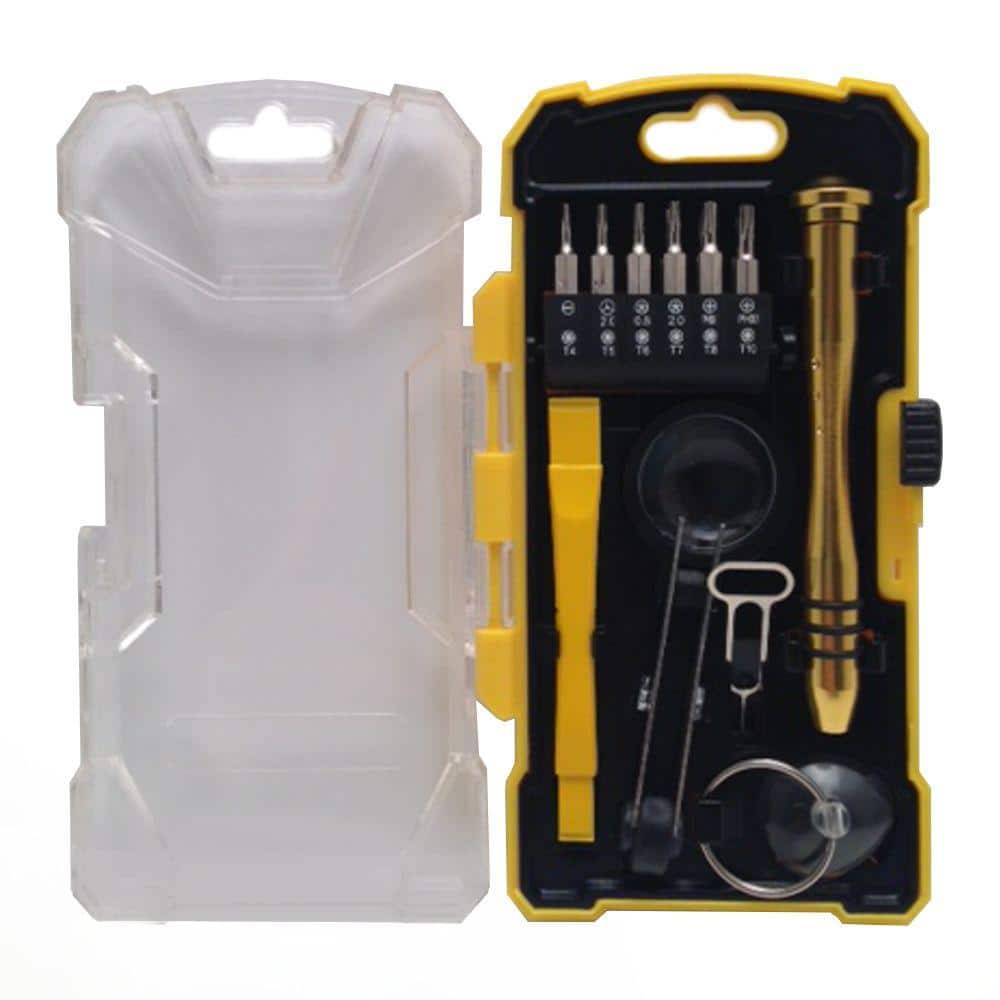
    Essential tools include:

    Basic Tools

    • Precision screwdriver set
    • Plastic pry tools
    • Tweezers
    • Opening picks
    • SIM ejector
    • Isopropyl alcohol (IPA)
    • Magnifying lamp

    Intermediate Tools

    • Soldering iron
    • Hot air rework station
    • Multimeter
    • DC power supply
    • PCB holder
    • Microscope (optional but helpful)

    Software Tools

    • Flashing tools (brand-specific)
    • Drivers and firmware files
    • Data recovery applications
    • Unlocking utilities (legal use only)

    High-quality tools protect devices from damage and improve your success rate.


    Dismantling and Assembling a Mobile Phone

    Correct dismantling prevents accidental damage to:

    • Display
    • Motherboard
    • Flex cables
    • Connectors
    • Fingerprint sensors

    Safe Dismantling Steps

    1. Power off the phone completely
    2. Remove SIM, SD card, and accessories
    3. Gently heat the back cover if it’s glued
    4. Use plastic tools—not metal—to lift edges
    5. Disconnect the battery before touching anything else
    6. Handle flex cables carefully—they tear easily
    7. Store screws in separate groups to avoid confusion

    Reassembling Tips

    • Never over-tighten screws
    • Ensure all connectors click into place
    • Clean surfaces with IPA before closing
    • Test everything before final sealing

    Identifying Motherboard Parts and Their Functions

    Understanding the roles of ICs helps you diagnose issues confidently.

    Important IC Components

    Power IC (PMIC):
    Controls battery power, charging, and voltage distribution.

    Charging IC:
    Handles fast charging, USB communication, and battery detection.

    Audio IC:
    Manages speakers, headphones, and microphone-related functions.

    Network IC / RF section:
    Controls SIM detection, signal strength, and mobile data.

    Backlight IC:
    Lights up the display; faulty IC causes dim or black screen.

    CPU & RAM:
    Brains of the phone—rarely replaced but often fail due to overheating or water damage.

    Learning how these parts interact dramatically improves your fault-finding ability.


    Diagnosing Hardware Problems

    Hardware faults are usually related to:

    • Battery issues
    • Display damage
    • Motherboard faults
    • Charging problems
    • Audio issues
    • Camera failures
    • Water damage

    Here’s how to approach them.


    1. Battery Problems

    Common symptoms:

    • Phone turns off randomly
    • Full charge drains rapidly
    • Device only works when plugged in

    Solutions:

    • Calibrate battery
    • Replace degraded battery
    • Check charging IC or PMIC if battery is new

    2. Display Problems

    Symptoms:

    • Touch not working
    • Flickering screen
    • Lines on display
    • Black screen

    Fix:

    • Replace LCD or AMOLED
    • Clean flex cable connection
    • Check display IC

    3. Charging Issues

    One of the most frequent hardware repairs.

    Symptoms:

    • Slow charging
    • Not charging at all
    • Phone heats while charging
    • Charging only at specific angles

    Fix:

    • Replace charging port
    • Clean connector pins
    • Test with DC power supply
    • Check Charging IC and PMIC if port is fine

    4. Camera Problems

    Symptoms:

    • “Camera failed” message
    • Blurry photos
    • Camera not opening

    Solutions:

    • Replace camera module
    • Clean connectors
    • Update or reset software

    5. Audio Problems

    Symptoms:

    • Caller can’t hear you
    • You can’t hear the caller
    • No sound in videos or apps

    Fix:

    • Replace speaker / mic
    • Reheat or replace Audio IC
    • Clean mesh filters (often clogged with dust)

    6. Water Damage Repairs

    Water damage is tricky but often repairable if treated quickly.

    Steps:

    1. Switch off device immediately
    2. Dry using absorbent cloth
    3. Open back cover
    4. Disconnect battery
    5. Clean motherboard with IPA
    6. Dry thoroughly before testing

    Never use a hairdryer—it can push moisture deeper.


    Diagnosing Software Problems

    Many issues are software-related and easy to fix.


    1. Device Running Slow

    • Clear cache
    • Uninstall heavy apps
    • Reset settings

    2. Boot Loop or Stuck Logo

    Often fixed by:

    • Flashing firmware
    • Wiping data and cache

    3. Network or SIM Issues

    Try:

    • Reset network settings
    • Replace SIM
    • Flash firmware
    • Check baseband status

    4. App Crashes

    • Update apps
    • Clear app data
    • Check storage space

    Flashing and Formatting Mobile Phones

    Flashing refers to reinstalling the phone’s operating system.
    Formatting refers to wiping user data.

    Why Flashing is Needed

    • Stuck on logo
    • Software corruption
    • Virus or malware
    • Forgotten password (legitimate use only)

    How to Flash Safely

    • Use official firmware only
    • Install correct drivers
    • Backup user data (if possible)
    • Fully charge the device
    • Never interrupt the flashing process

    Using the wrong firmware can permanently damage the device, so accuracy matters.


    Practical Tips and Tricks for Repair Technicians

    Here are the most useful mobile repair insights gathered from real-world experience.

    1. Always Start with Visual Inspection

    Look for:

    • Burn marks
    • Corrosion
    • Loose ICs
    • Broken connectors
    • Missing components

    2. Use a Multimeter for Quick Diagnosis

    Check:

    • Continuity of tracks
    • Short circuits
    • Voltage output from PMIC

    3. Clean First, Repair Later

    A huge number of issues are caused by:

    • Dirt
    • Moisture
    • Loose connectors

    4. Avoid Excessive Heat

    Too much heat:

    • Warps the motherboard
    • Damages ICs
    • Melts flex cables

    Use proper temperature ranges.

    5. Maintain a Troubleshooting Checklist

    This prevents missing simple solutions.

    6. Follow “Least Risk First” Approach

    Example:

    • Try cleaning → reconnecting → replacing minor parts → motherboard repair.

    7. Keep Learning

    Mobile technology changes fast.
    Forums, YouTube channels, and training institutes help build expertise.


    Common Mistakes and How to Avoid Them

    Mistake 1: Using metal tools on delicate parts

    Can cause short circuits.

    Mistake 2: Skipping ESD protection

    Electrostatic discharge can damage ICs.

    Mistake 3: Rushing during dismantling

    Leads to torn flex cables.

    Mistake 4: Ignoring battery safety

    Damaged batteries can swell or burst.

    Mistake 5: Flashing wrong firmware

    Causes dead phone or corrupted partition.


    When a Phone Is “Beyond Repair”

    A phone becomes near-impossible to repair when:

    • CPU or RAM is internally damaged
    • Motherboard is severely burnt
    • Board layers are broken
    • Severe corrosion has eaten through tracks
    • Device fails even after IC replacement

    However, skilled board-level technicians can still revive many cases that seem impossible.


    How to Improve Your Repair Skills Quickly

    1. Practice on Old Phones

    Before handling expensive devices.

    2. Watch Live Repair Videos

    Helps you understand real scenarios.

    3. Join Technician Communities

    Forums and groups offer daily learning.

    4. Learn Microsoldering

    Increases your repair success rate.

    5. Stay Updated

    New phone models require new methods.


    Conclusion

    Mobile phone repair is a blend of knowledge, observation, and hands-on practice. When you understand how phones work and follow a systematic troubleshooting approach, even complex problems become simple.

    Whether you’re repairing for personal use or building a professional career, the tips in this guide will help you diagnose faults faster, avoid common mistakes, and build confidence.

    If you approach every device with patience and curiosity, your skills will grow naturally and consistently.

  • How To Repair Your Cell Phone Yourself: Easy DIY Guide

    How To Repair Your Cell Phone Yourself: Easy DIY Guide

    Smartphones are an essential part of daily life. We use them for communication, payments, work, navigation, entertainment, and storing personal memories. When something goes wrong, even a minor issue can feel extremely stressful. Many people rush to a repair shop for every small problem, not realizing that most phone issues are simple and can be fixed at home with basic knowledge.

    This easy, practical guide is designed for beginners, DIY enthusiasts, and anyone curious about how mobile repair works. You don’t need advanced tools or special technical training to fix many common problems. All you need is patience, careful handling, and the right steps.

    As a well-known technician once said, “A phone isn’t complicated—it becomes complicated only when you panic.”
    With the right approach, even tough-looking issues become simple.

    Let’s explore everything you need to know to repair your phone yourself safely and confidently.


    Understanding the Type of Problem (Most Important Step)

    Every repair begins with one essential question:

    What kind of problem is your phone facing?

    Before attempting any fix, identify the category of fault.
    Almost all mobile issues fall into three main types:

    1. Settings Faults
    2. Hardware Faults
    3. Software Faults

    Once you know the category, choosing the right troubleshooting step becomes easy.


    1. Settings Faults: Simple Issues That Need Quick Fixes

    Settings faults are minor problems caused by incorrect settings, accidental changes, or temporary glitches. They are the easiest to fix.

    Examples include:

    • Unable to make or receive calls
    • Phone switching off while opening gallery
    • SMS inbox causing the phone to freeze
    • Screen rotation not working
    • WiFi or Bluetooth behaving strangely
    • Sound profile stuck on silent

    In most cases, these issues are small and can be solved with basic steps.


    Step 1: Restart Your Phone

    This is the simplest and most effective method. Restarting clears temporary bugs and refreshes the system.

    Most problems are fixed simply by restarting.


    Step 2: Reset the Settings (Not Factory Reset)

    If restart doesn’t work, try resetting settings without deleting your data.

    Go to:

    Settings → System → Reset → Reset All Settings

    This restores default system behavior while keeping:

    • Photos
    • Apps
    • Contacts
    • Files

    This is a safe option for beginners.


    Step 3: Factory Reset (Use Only If Needed)

    If the issue continues, perform a factory reset.

    Settings → System → Reset → Factory Data Reset

    This removes:

    • Installed apps
    • Customizations
    • Cached faults
    • Unwanted files

    Your phone becomes fresh like when it was new.

    Important:
    You must remember the security code or screen lock; otherwise, the phone will not allow the reset.

    If a reset does not fix the issue, it may belong to hardware or software categories.


    2. Hardware Faults: Problems Related to Physical Components

    Hardware issues occur due to damage, wear and tear, loose connections, dust, moisture, or failing parts. These problems often require basic tools and careful handling.

    Common hardware problems include:

    You may be surprised to know that many hardware faults are caused by dirt, loose connections, or minor corrosion, not by major damage.


    Before Opening Your Phone: Important Safety Rules

    • Never open the phone if it’s under warranty — you will lose it.
    • Work on a clean surface with good lighting.
    • Use a proper phone opening tool kit (avoid sharp household tools).
    • Disconnect the battery connector first before touching anything else.
    • Do not apply force to connectors or cables.

    If at any point you feel unsure, stop immediately.


    Step-by-Step Hardware Repair Guide (Beginner Friendly)


    Step 1: Watch a Model-Specific Opening Video

    Search:

    “How to open <your phone model> back cover”

    This ensures you don’t damage internal flex cables or the plastic frame.

    YouTube has detailed videos for almost every phone model.


    Step 2: Clean Dust and Connections

    Most hardware faults happen because:

    • Dirt blocks sensors
    • Speaker mesh gets clogged
    • Charging port filled with dust
    • Button flex loses contact
    • Connectors move slightly out of place

    Use:

    • Soft brush
    • Isopropyl alcohol (IPA)
    • Microfiber cloth
    • Compressed air

    Do not use water or liquid cleaners.


    Common Hardware Fixes You Can Do Yourself

    • Charging Issues

    Reasons:

    • Dust inside charging port
    • Loose port
    • Damaged cable

    Try:

    • Clean the charging port gently
    • Try a different charger
    • Check if the charger supports fast charging

    If the port is physically broken, you may need replacement, which beginners should avoid attempting alone.


    • Speaker or Microphone Not Working

    Often caused by:

    • Dust
    • Blocked grills

    Fix:

    • Clean the grills
    • Check sound settings
    • Test with earphones to confirm

    If sound works on earphones but not on speaker, the speaker module may need replacement.


    • Touchscreen Not Working

    Try:

    • Clean the screen
    • Restart
    • Enter safe mode (to check if an app is causing it)
    • Remove any tempered glass that might be affecting touch

    If still unresponsive, the touch panel may be damaged.


    • Buttons Not Functioning

    Side buttons fail due to:

    • Dust
    • Loose flex
    • Physical damage

    Cleaning and reconnecting the flex often solves the issue.


    • Camera Not Opening

    Try:

    • Restart
    • Clear camera app cache
    • Check for loose connector

    If the camera shows a black screen, the module may need replacement.


    When to Stop DIY Hardware Repair

    Some repairs are unsafe for beginners:

    • Replacing charging IC
    • Fixing motherboard shorts
    • Microsoldering
    • Replacing display IC
    • Heating motherboard components

    If cleaning and reconnecting don’t solve the problem, take it to a trained technician.


    3. Software Faults: Issues Caused by System or Apps

    Software faults are extremely common today because smartphones depend heavily on apps and operating systems. These problems are easier to fix compared to hardware repairs.

    Common software issues:

    • Phone hanging
    • Freezing during calls
    • Apps crashing
    • Automatic restart
    • Stuck at boot logo
    • Slow phone performance
    • Touch lag
    • System glitches
    • Overheating due to apps

    Step-by-Step Software Repair Guide


    Step 1: Restart

    Simple but effective.


    Step 2: Free Up Storage Space

    Low storage is the #1 reason for lag.

    Delete:

    • Large videos
    • Old WhatsApp media
    • Unused apps
    • Duplicate photos

    Aim to keep at least 20–30% free storage.


    Step 3: Clear Cache of Heavy Apps

    Apps like YouTube, Instagram, Facebook, browser apps store large cache files.

    Go to:

    Settings → Apps → Select App → Storage → Clear Cache

    This improves speed instantly.


    Step 4: Update Apps and System Software

    Updates include bug fixes and performance improvements.


    Step 5: Reset Settings

    Restores stable system behavior. If its a feature phone, it will ask for security code. Enter default security code if the code has not been changed. Your problem should get solved. If you are not lucky, you will have to format (factory reset) or flash your handset.


    Step 6: Factory Reset

    Removes deeper issues like:

    • Virus infections
    • Corrupted files
    • Boot loop errors
    • Slow performance

    Backup your data first.


    Step 7: Flash or Update Firmware

    If the phone still has issues:

    • Flash the stock firmware
    • Install updated OS package
    • Restore original system files

    This requires tools, firmware files, and basic understanding. If you want to know more about flashing, read what is flashing and how to flash a mobile phone.

    Beginners should attempt only with proper guidance, otherwise consult a technician.


    Bonus: Common Mistakes to Avoid During DIY Repair

    • Not backing up data
    • Using excessive heat on the phone
    • Applying force while opening
    • Using metal tools that cause short circuits
    • Mixing up screws
    • Touching motherboard circuits with fingers
    • Skipping battery disconnection

    A careful, patient approach always gives better results.


    When Should You Not Repair the Phone Yourself?

    DIY repair is great—but not for everything.

    Avoid DIY if:

    • The screen is cracked badly
    • Motherboard has water damage
    • Phone has no power at all
    • Components require soldering
    • Burning smell or smoke is present
    • Device repeatedly gets hot even when idle

    In such cases, DIY attempts may worsen the damage.

    If you wish to build a career in mobile phone repairing, selecting the right institute is the first step. This curated list of Mumbai’s best mobile repairing course institutes can help you start on the right path.


    Real-Life Example: A Simple Problem Made Complicated

    A user complained that their phone wasn’t charging. They assumed the motherboard was damaged and tried to open the device. In reality, the charging port was filled with lint from the pocket. Once cleaned carefully, the phone worked perfectly.

    Lesson:
    Not every problem is serious. Sometimes, a simple cleaning saves time and money.


    Final Tips for Safe DIY Phone Repair

    • Work slowly
    • Keep tools organized
    • Watch tutorials for your exact model
    • Always disconnect the battery first
    • Replace parts only when necessary
    • Maintain backups regularly
    • Don’t panic—phones are simpler than they appear

    As one technician says, “You fix a phone with patience before tools.”


    Conclusion

    Repairing your phone yourself is completely possible. Most issues—whether settings, software, or hardware—can be fixed using simple steps that require no advanced skill. By understanding the type of problem, applying the right method, and following safety precautions, you can save money and avoid unnecessary service center visits.

    However, know your limits. When repairs involve motherboard components, soldering, or severe hardware damage, it’s better to leave the job to professionals.

    DIY phone repair is empowering, practical, and surprisingly easy once you understand the basics. Start small, follow the right steps, and your confidence and skill will grow naturally.

  • How to Use a Multimeter for Mobile Phone Repair (Guide)

    How to Use a Multimeter for Mobile Phone Repair (Guide)

    A multimeter is one of the most essential tools in mobile phone repairing. Whether you are troubleshooting power issues, tracking short circuits, or testing tiny components on the motherboard, this tool helps you diagnose faults with accuracy.

    Understanding how to use a multimeter not only makes your work easier but also improves the chances of repairing a device correctly on the first attempt.

    “Good tools make you skilled. Understanding those tools makes you unstoppable.”

    This guide explains everything in a clean, simple manner — what a multimeter does, how to use it in phone repair, the meaning of each mode, real-life examples, and practical tips from repair experience. Even if you’re a complete beginner, you’ll feel confident using a multimeter by the end of this article.


    What Is a Multimeter and Why Is It Important in Mobile Repair?

    A multimeter is a measuring instrument used to test voltage, resistance, continuity, and electronic components. In mobile phone repair, it helps technicians to:

    • Check whether the battery or charging section is working
    • Detect short circuits on the motherboard
    • Measure voltage output from charging points
    • Test components like resistors, capacitors, speakers, ringers, and microphones
    • Verify if tracks and connections are intact
    • Diagnose dead or non-booting devices

    The multimeter acts like the eyes of a technician. Without it, you are guessing. With it, you know exactly what is happening inside the phone.

    “Electronics don’t fail without a reason — a multimeter helps you find that reason.”


    Types of Multimeters: Which One Should You Use?

    There are two major types:

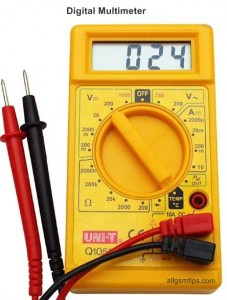
    1. Digital Multimeter (DMM)

    This is the most widely used multimeter today. It shows readings in numerical form on a screen and gives faster, more accurate results.

    digital multimeter

    Benefits:

    • Easy to read
    • More accurate
    • Compact and lightweight
    • Ideal for delicate smartphone components
    • Has built-in functions like auto-range in advanced models

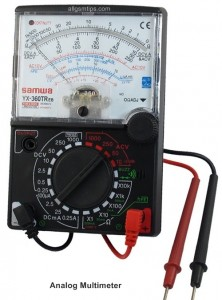
    2. Analog Multimeter

    This multimeter uses a needle and scale to show readings. It is old, retro type used by a very few old and senior technicians only.

    Older technicians still like it because:

    • It shows variations smoothly
    • It works well for some deep testing scenarios
    Analog Multimeter

    However, for mobile repair, digital models are preferred because the components are very small and require precise measurement.


    Understanding Probes and Ports

    Every multimeter comes with two probes:

    • Red probe = Positive (+)
    • Black probe = Negative (–)
    using a multimeter in mobile repairing

    On the meter, you’ll see port labels such as:

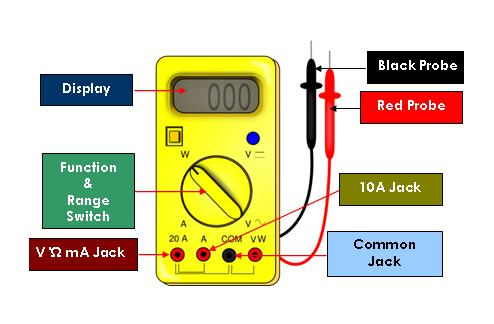
    • COM → Common port (black probe goes here)
    • VΩmA → Voltage/Resistance port (red probe goes here)
    • 10A/20A → High current port (not used in mobile repair)

    For mobile phone diagnostics, you only use COM and ports. Insert black probe in COM port and the black probe in the VΩmA port

    Incorrectly inserting probes into the high-current port can damage both the meter and the phone, so handle carefully.


    Important Multimeter Settings Used in Mobile Repair

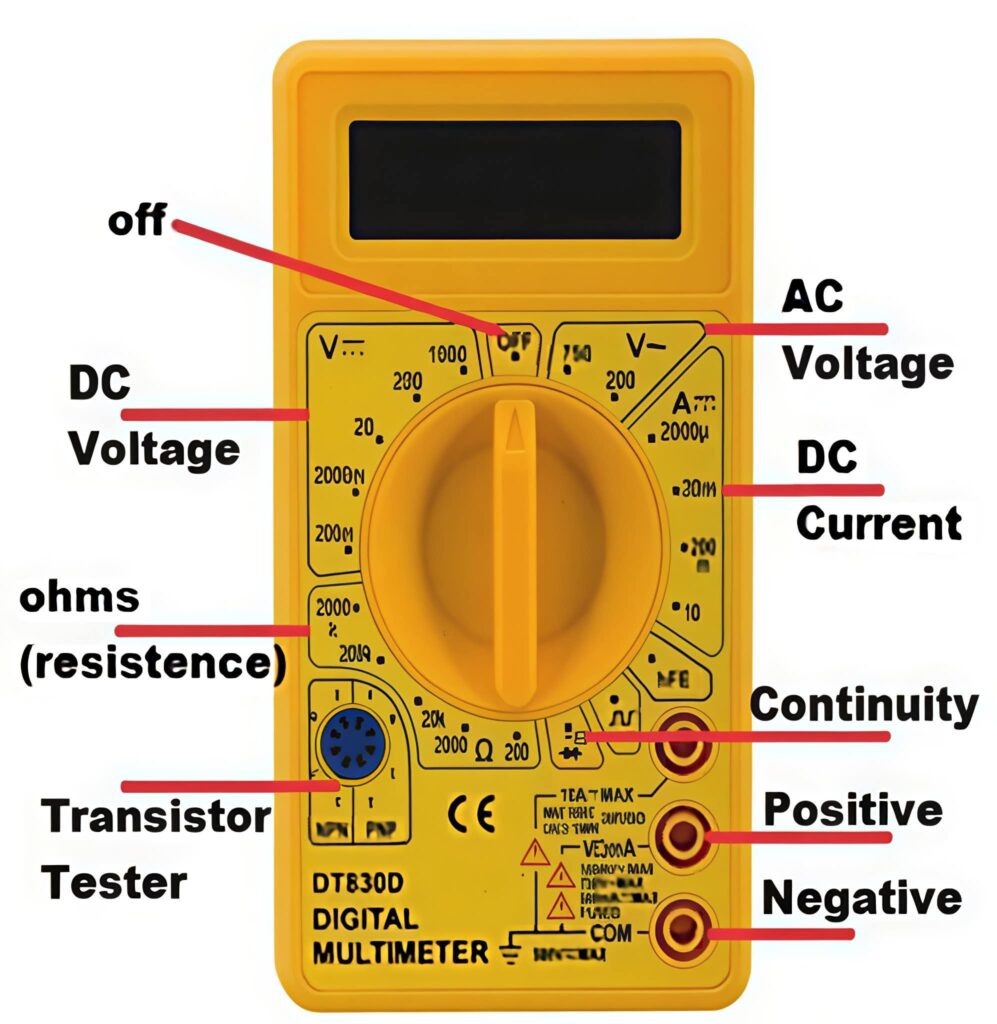
    A multimeter has several settings, but mobile technicians mainly use these 3 settings only:

    how to use a multimeter in cell phone repairs

    1. DC Voltage Mode (V⎓)

    This mode is used to measure the voltage of:

    • Batteries
    • Battery connectors
    • Charging input
    • Power rails on the motherboard
    • Boost converters and regulators

    How to Use DC Voltage Mode

    1. Turn the dial to DC voltage (symbol: V with straight line and dots).
    2. Connect the black probe to ground (battery negative or metal shielding).
    3. Touch the red probe to the point you want to measure.
    4. Read the voltage displayed on the screen.

    Use Cases in Mobile Repair

    • Checking if the battery has proper voltage
    • Testing whether the charging port is supplying power
    • Verifying voltage at PMIC output lines
    • Checking if the phone is getting power when the ON button is pressed

    Example

    A healthy Li-ion mobile battery normally shows around 3.7V–4.3V depending on charge level.

    If the battery connector shows 0V, the device will not power ON — a sign of a charging IC or power rail issue. Learn how to check a smartphone battery with a multimeter in details


    2. Resistance Mode (Ω)

    Resistance mode helps measure:

    • Resistors
    • Coils
    • Internal lines
    • Microphone types
    • Faulty components in the network section

    How to Use Resistance Mode

    1. Set the multimeter to Ω.
    2. Touch the probes to both ends of the component.
    3. Compare the reading with standard values or schematic diagrams.

    Use Cases in Mobile Repair

    • Testing resistors and their values
    • Checking if a coil is open
    • Identifying high-resistance lines causing signal issues
    • Testing electret microphones (older devices)
    • Checking component failure after water damage

    If a resistor reads or extremely high Ω beyond its rated value, it is faulty.


    3. Continuity Mode (Beep Mode / Diode Mode)

    This is one of the most used settings in phone repair.

    What It Does

    When you touch two points that are connected internally, the multimeter:

    • Beep sound (in most models)
    • Or shows a continuity reading (in some models)

    This mode helps you check if a track, line, or component connection is complete.

    How to Use Continuity Mode

    1. Set the dial to the continuity or diode symbol.
    2. Touch the two probes together — you should hear a beep.
    3. Now touch the probes to the two points you want to test.

    Use Cases

    • Checking broken PCB tracks
    • Checking jumpers
    • Testing speaker terminals
    • Testing ringer and vibrator motor
    • Checking whether the motherboard has a short circuit
    • Testing battery connector polarity

    Detecting a Short Circuit

    Shorting is a common issue in dead or overheating phones.

    To test:

    1. Place probes on the battery connector terminals.
    2. Check in one direction.
    3. Reverse the probes and check again.

    Results:

    • Beep both ways → Motherboard is short
    • Beep only once → Normal
    • Very low diode reading both ways → Short
    • One side shows value, other side shows 1 (open) → Normal

    Different phones show different readings, so rely on pattern recognition and experience.


    Testing Common Components Using a Multimeter

    Below is a practical guide for checking the most common parts in a mobile phone.


    1. Testing a Speaker

    Speakers usually show a resistance between 8Ω–32Ω.

    Steps:

    1. Set the meter to continuity or resistance.
    2. Touch probes to speaker terminals.
    3. Beep or a stable resistance value = good speaker.
    4. No response = speaker damaged.

    2. Testing a Microphone

    Modern smartphones use digital microphones, which require dedicated testing tools. However, older devices had electret mics that can still be tested.

    Steps for older mic types:

    1. Use the resistance mode.
    2. Check for reading within specified range.

    If readings are unstable, the mic may be faulty.


    3. Testing a Ringer / Buzzer

    Buzzers behave like speakers.

    Steps:

    1. Use continuity mode.
    2. Beep or small resistance = working.
    3. No beep = faulty.

    4. Testing Charging Connector

    A multimeter helps detect:

    • Loose connector
    • Faulty pins
    • No output voltage from the charger

    Steps:

    1. Use DC voltage mode.
    2. Connect charger.
    3. Check pins for output (usually 5V).

    If voltage is missing or fluctuating, the charging section needs repair.


    5. Testing Battery Health

    A battery is considered functional if it holds sufficient voltage.

    Typical values:

    • Fully charged: 4.2V
    • Normal state: 3.7V–3.9V
    • Deep discharge: below 3.0V

    Batteries below 3.0V might not charge and may need boosting.


    How to Check Short Circuits on the Motherboard

    Short circuits are one of the most common causes of dead phones.

    Steps:

    1. Set the meter to continuity or diode mode.
    2. Place probes on battery positive and negative.
    3. Listen for the beep.

    Beep in both directions = Short circuit.
    Beep only one way = Normal.

    Once a short is confirmed, technicians begin isolating sections such as:

    • Charging IC
    • PMIC
    • Capacitors
    • CPU/SoC lines

    Most shorts are caused by tiny capacitors near the battery line.

    Read in detail how to check shorting in mobile phones.


    Best Practices for Using a Multimeter in Mobile Repair

    Using a multimeter correctly not only gives accurate results but also protects sensitive components.

    ✔️ Always use the correct mode

    Using the wrong mode, especially AC voltage, can damage your motherboard.

    ✔️ Keep probes steady

    Shaking hands can touch multiple lines and cause further damage.

    ✔️ Understand ground points

    The metal shield, screw areas, and negative terminal all serve as ground.

    ✔️ Use sharp probes

    Sharp tips help test tiny SMD components.

    ✔️ Avoid cheap multimeters

    They give inaccurate readings that can lead to wrong diagnosis.

    ✔️ Compare readings with another working board

    This is the best way to train your understanding.


    Real-Life Repair Scenarios Using a Multimeter

    Below are common examples from practical repair work.


    Scenario 1: Phone Not Powering On

    Steps:

    1. Test battery voltage (DC mode).
    2. Test battery connector output.
    3. Check continuity between power button line and ground.

    This identifies whether the issue is with the battery, connector, or power IC.


    Scenario 2: Phone Overheating

    Overheating often indicates a short.

    Use continuity mode to test major power rails. If the meter beeps both ways, the line is short.


    Scenario 3: Not Charging

    Use DC voltage mode to:

    • Check voltage at charging port
    • Test input at charging IC
    • Verify voltage reaching battery terminal

    This helps pinpoint whether the problem is mechanical or motherboard-level.


    Common Multimeter Mistakes Technicians Should Avoid

    • Using multimeter on wrong mode
    • Touching components with excessive pressure
    • Testing on wet motherboards
    • Not removing the battery while testing resistance
    • Assuming all beeps indicate a short
    • Using low-quality probes

    Even experienced technicians occasionally make these mistakes, so awareness is important.


    Conclusion

    A multimeter is one of the smartest investments you can make as a mobile repair technician. With this single tool, you can diagnose power issues, find shorts, test components, and understand the health of the motherboard.

    More importantly, it builds your confidence.

    A technician who knows how to use a multimeter can solve almost any hardware-level problem.

    “Master your tools, and your tools will master every fault you face.”

  • Common Cell Phone Problems: Full List of Faults Explained

    Common Cell Phone Problems: Full List of Faults Explained

    Cell phones have become our closest companions. They wake us up, connect us, entertain us, and store our memories — so when a phone stops working, even a small fault can disrupt our entire routine. For repair technicians, understanding these issues is essential. For users, knowing the common problems helps you stay prepared and identify faults early.

    “Every problem has a root cause — the real skill lies in finding it.”

    This guide explains all major mobile phone faults, how they occur, what they mean, and how technicians typically diagnose them. The goal is to give you a clear, updated, and practical understanding of today’s smartphone issues — in simple language.


    Types of Mobile Phone Faults

    All phone problems fall into three broad categories:

    1. Settings-Related Faults

    These occur due to wrong configurations, disabled features, changed options, or simple mistakes made by the user.

    2. Software Faults

    These involve the phone’s operating system, apps, corrupt files, firmware crashes, or update failures.

    3. Hardware Faults

    These are physical failures such as broken displays, damaged charging ports, faulty motherboards, or non-working components.

    Understanding which category the issue belongs to helps technicians diagnose faster and more accurately.


    Full List of Modern Mobile Phone Faults (Updated)

    Below is an expanded and updated list of all common smartphone faults, including newly emerging issues found in today’s touchscreen devices.
    Obsolete or outdated faults (from keypad-era phones) have been removed, updated, or rewritten.


    1. Dead Phone (Not Powering On)

    A phone that doesn’t turn on, doesn’t vibrate, and shows no charging sign is considered dead.
    Causes may include:

    • Battery failure
    • Water damage
    • Short circuit
    • Faulty power IC (PMIC)
    • Damaged charging port

    Technicians diagnose this using power supply tools and multimeters.


    2. SIM Card Not Detected

    The phone shows “No SIM” or “Insert SIM Card” even when the SIM is inserted.
    Usually caused by:

    • Dirty or bent SIM pins
    • Damaged SIM slot
    • Software conflict
    • Network IC failure

    Modern eSIM phones may show activation issues instead.


    3. Hanging / Freezing / Lagging

    The cell phone becomes unresponsive or slow.
    Causes include:

    • Low storage
    • Heavy apps
    • Overheating
    • Corrupted firmware
    • Faulty RAM or CPU chip

    A common sign of deeper software damage.


    4. Network Issues (No Signal / Low Signal / Dropping Calls)

    This includes:

    • No network
    • Weak signal
    • “Emergency calls only”
    • Calls dropping automatically

    Reasons:

    • Damaged antenna
    • SIM issues
    • Firmware bugs
    • Network IC failure

    5. Microphone Not Working

    People cannot hear you during calls or voice recordings.

    Common reasons:

    • Dust in MIC hole
    • Water damage
    • Damaged MIC module
    • Firmware glitch
    • Noise cancellation mic fault

    Modern phones have multiple microphones, so diagnosis requires precision.


    6. Speaker Issues (No Sound During Calls)

    The earpiece speaker stops working, making you unable to hear the caller.

    Usually caused by:

    • Dust buildup
    • Flex cable damage
    • Moisture
    • Faulty earpiece speaker

    7. Loudspeaker / Media Speaker Fault

    No ringtone, music, notifications, or hands-free audio.

    Reasons:

    • Faulty loudspeaker unit
    • Software audio routing issue
    • Audio IC failure

    8. Vibration Not Working

    Vibration motor (haptic motor) stops functioning.

    Common causes:

    • Motor wear-out
    • Loose connection
    • Board damage

    9. Display / Screen Faults

    This includes:

    • Blank screen
    • Broken or cracked display
    • Flickering issue
    • Green/pink lines
    • Black spots
    • No backlight
    • Touch working but no display
    • Display working but touch not responding

    Modern OLED screens also face:

    • Burn-in
    • Ghosting
    • Color shifts

    10. Auto Power Off

    Phone switches off randomly without user action.

    Reasons:

    • Overheating
    • Battery failure
    • Power IC malfunction
    • Corrupt firmware

    11. Auto Restart (Bootloop)

    The phone continuously restarts or gets stuck on the logo.
    Causes:

    • System update failure
    • Damaged OS
    • Application conflict
    • Hardware shorting
    • Damaged booting IC

    Bootloops are common after failed software updates.


    12. Call Drops / Call Disconnecting

    The call ends abruptly.
    This may be due to:

    • Weak network
    • Software bugs
    • Damaged antenna
    • Faulty baseband IC

    13. Charging Problems

    One of the most common faults today. Includes:

    • Not charging
    • Slow charging
    • Intermittent charging
    • Overheating while charging
    • Charger connected but not increasing battery percentage

    Reasons:

    • Faulty cable or adapter
    • Broken charging port
    • Charging IC damage
    • Battery swelling
    • Dirt inside port

    14. Charging Port Damage (USB Port Faults)

    When the port becomes loose, bent, corroded, or physically damaged.
    Symptoms:

    • Cable must be held at an angle
    • Charging stops when moved
    • No data transfer

    15. Touchscreen Problems

    Touch issues are very common today.

    Includes:

    • Touch not working
    • Touch responding on its own (ghost touch)
    • Slow or delayed touch
    • Touch working only in some areas

    Causes:

    • Damaged touch panel
    • Faulty display connector
    • Software glitch

    16. Battery Draining Fast

    Battery percentage drops quickly even with light usage.
    Reasons:

    • Battery health degraded
    • Power-hungry apps
    • Background processes
    • Network fluctuations
    • Faulty charging IC
    • Swollen battery

    Technicians use software and multimeter tools to confirm battery health.


    17. Overheating Problems

    Phone becomes hot during use, charging, or even idle.

    Causes:

    • Heavy gaming
    • Faulty CPU
    • Short circuit
    • Damaged battery
    • Poor ventilation
    • Malware apps

    If the phone overheats too much, it may shut down automatically.


    18. Bluetooth Not Working

    Bluetooth won’t connect, keeps disconnecting, or doesn’t turn on.

    Reasons:

    • Corrupted Bluetooth firmware
    • Radio frequency interference
    • Damaged Wi-Fi/Bluetooth IC

    19. Wi-Fi Not Connecting

    Wi-Fi may show:

    • No connection
    • Authentication error
    • Frequent disconnection

    Possible causes:

    • Router conflict
    • Software bugs
    • Wi-Fi IC damage

    20. Mobile Data Not Working

    Internet does not work even though network bars are visible.

    Causes include:

    • APN settings wrong
    • Corrupt OS
    • Network provider issue
    • Baseband malfunction

    21. Camera Problems

    Modern camera modules face several faults:

    • Camera not opening
    • “Camera failed” error
    • Blurry pictures
    • Black screen when switching lenses
    • Ultrawide/macro lens not detecting
    • Front camera not working
    • Portrait mode failure
    • Video stabilization not working

    Some premium phones also face OIS motor failure.


    22. Fingerprint Sensor Not Working

    Includes:

    • No fingerprint detection
    • Slow recognition
    • Error in setup
    • In-display fingerprint failure

    Usually caused by:

    • Damaged sensor
    • Moisture
    • Software conflicts

    23. Face Unlock Not Working

    Face ID or Face Unlock may stop working due to:

    • Dirty front camera
    • Low light
    • Damaged sensors
    • Software update issues
    • TrueDepth camera failure (iPhone)

    24. Memory Card Not Detected

    For phones with SD card slots.

    Reasons:

    • Corrupted SD card
    • Dirty contacts
    • Damaged slot
    • Unsupported file format

    25. Proximity Sensor Issue

    Screen does not turn off during calls or turns off at the wrong time.

    Causes:

    • Screen guard blocking sensor
    • Sensor misalignment
    • Calibration error

    26. GPS / Location Problems

    Navigation becomes inaccurate or fails to track position.

    Reasons:

    • Weak GPS antenna
    • Software bugs
    • Location services turned off
    • Corrupted system files

    27. App Crashing / App Not Opening

    Apps force-close due to:

    • Outdated version
    • Low RAM
    • OS conflict
    • Corrupted data

    28. Storage Full Even When Not Used

    A common issue in modern phones.

    Reasons:

    • System cache
    • Duplicate files
    • Hidden media
    • Malware apps
    • Defective memory chip (EMMC/UFS)

    Technicians check using special memory analysis tools.


    29. Phone Not Detecting on Computer (USB Data Failure)

    Includes:

    • PC not recognizing phone
    • No file transfer
    • Only charging but no MTP mode

    Reasons:

    • Faulty USB driver
    • Cable issues
    • Data pins damaged
    • Motherboard fault

    30. Notification Problems

    User does not receive notifications on time.

    Occurs due to:

    • Battery optimization restrictions
    • Disabled app permissions
    • Software bugs

    31. Liquid Damage Faults

    Water damage causes unpredictable issues such as:

    • Touch not working
    • Speaker distortion
    • Charging short
    • No power
    • Corrosion on connectors

    Liquid damage requires deep cleaning and board-level diagnosis.


    32. Software Update Issues

    Phones may face:

    • Update stuck
    • Update failure
    • Feature missing
    • Battery draining after update

    Some updates introduce bugs that require patch fixes.


    33. Bootloader / FRP / Account Lock Issues

    Phones sometimes get locked due to:

    • Forgot password
    • Factory reset protection (FRP)
    • Carrier lock
    • Bootloader relocking

    Technicians use specialized software tools to resolve these cases (lawfully).


    34. Audio IC Failure (Common in Certain Models)

    Symptoms:

    • No sound
    • Voice not recorded
    • Speaker disabled
    • Microphone not detecting
    • Call drops when enabling loudspeaker

    This is a common board-level hardware problem.


    35. Backlight Failure

    Screen is ON but completely dark unless viewed under direct light.

    Causes include:

    • LED backlight strip damage
    • Backlight driver IC failure
    • Blown backlight filter

    Learn how to troubleshoot the most common cell phone faults by reading How To Repair Your Cell Phone Yourself


    Conclusion

    Mobile phones may look simple from the outside, but they contain hundreds of delicate components inside. Knowing the different types of faults helps technicians diagnose issues faster and gives users a better understanding of what might be wrong with their device.

    “A fault diagnosed well is already half repaired.”

    If you want to learn how to fix many of these problems yourself, always start with simple checks before attempting advanced repairs.

  • Most Common Phone Issues and How to Fix Them Easily

    Most Common Phone Issues and How to Fix Them Easily

    Smartphones have become an essential part of our daily lives. We rely on them for communication, entertainment, work, payments, navigation, and even security. But like all electronics, phones develop problems—sometimes due to usage habits, sometimes because of apps or software glitches, and often because of accidental damage.

    The good news is that most phone issues are easy to fix if you understand what causes them and take quick action. Whether you’re using an iPhone, Samsung, Xiaomi, Vivo, Oppo, Motorola, OnePlus, or any other brand, the types of problems you face are often similar.

    “Every problem has a solution—what matters is knowing where to look.”

    This guide explains the most common smartphone issues and provides simple, practical solutions anyone can follow. It’s written for both everyday users and those learning mobile repair.


    1. Cracked or Broken Display

    A cracked screen is one of the most common smartphone problems. Modern phones use glass displays for clarity and touch responsiveness, but this also makes them fragile.

    Common Causes

    • Accidental drops
    • Pressure on the pocket
    • Falling off the bed or table
    • Sharp objects inside bags

    Solutions

    • If the crack is minor, apply a tempered glass to prevent it from spreading.
    • If touch stops working or lines appear, replace the display.
    • Choose original or premium-grade compatible screens for long-term use.
    • Use a shock-absorbing case and a screen protector to prevent future damage.

    Important Tip:
    Display replacement costs vary widely between brands. Check pricing before purchasing a phone or spare part.


    2. Charging Port Problems

    Charging port issues are extremely common because the port is used daily and exposed to dust, lint, and frequent pressure.

    Symptoms

    • Phone charges only when the cable is moved
    • Slow charging
    • Intermittent charging
    • No charging at all

    Causes

    • Dust or lint inside the port
    • Worn-out pins
    • Faulty cable or adapter
    • Water or moisture damage

    Solutions

    • Clean the charging port with a soft brush or wooden toothpick (never use metal).
    • Try a different cable and adapter.
    • Check for loose or wobbly ports, which require port replacement.
    • Use high-quality original or certified accessories.

    Preventive Tip

    Avoid using the phone while charging. This puts extra pressure on the port and loosens it over time.


    3. Battery Draining Fast

    Modern lithium-ion batteries degrade naturally over time, but fast battery drain may indicate deeper problems.

    Common Causes

    • Too many apps running in the background
    • Screen brightness set too high
    • Weak network coverage
    • Background syncing
    • Aging battery
    • Heavy gaming or streaming
    • Battery-intensive apps

    Solutions

    • Enable Battery Saver or Low Power Mode.
    • Keep brightness on auto or reduce manual brightness.
    • Turn off Bluetooth, GPS, or Wi-Fi when not needed.
    • Remove apps that drain battery excessively.
    • Replace the battery if it is worn out.

    Modern Battery Care Facts (Updated)

    To extend battery life:

    • Avoid letting your phone drop below 20% frequently.
    • Avoid charging to 100% all the time—80% is healthier for long-term battery life.
    • Enable Optimized Battery Charging (iPhone/Samsung/OnePlus).
    • Avoid fast charging continuously; mix between normal and fast charging.

    4. Freezing or Hanging Issues

    A phone that freezes or becomes unresponsive can be frustrating.

    Causes

    • Low storage
    • Unoptimized apps
    • Outdated software
    • RAM overload
    • Malware

    Solutions

    • Restart the phone once a day.
    • Clear app cache (Android).
    • Uninstall unnecessary apps.
    • Update apps and system software.
    • Check storage—keep at least 20% free space.
    • Use antivirus or malware scanners if needed.

    If the device still hangs, it may require a factory reset or software flashing.


    5. Slow Performance

    Slow phones are extremely common, especially as devices age.

    Common Causes

    • Too many apps installed
    • Background processes
    • Low internal storage
    • Failing storage chip (EMMC/UFS)

    Solutions

    • Clear cache regularly.
    • Delete duplicate files and heavy media.
    • Move photos/videos to cloud or external storage.
    • Restore factory settings if slowing becomes severe.

    Note:
    Avoid using memory cleaning apps that promise speed boosts—they often make performance worse.


    6. Overheating Problems

    Phones heat up naturally under heavy use, but excessive heat needs attention.

    Causes

    • Intense gaming
    • Video streaming
    • Weak network
    • Background apps running
    • Charging while using
    • Poor ventilation

    Solutions

    • Give the phone short breaks during heavy use.
    • Remove the cover while charging.
    • Avoid using fast charging continuously.
    • Update apps—poor coding may cause heat.
    • Reset or replace battery if overheating persists.

    Important:
    Severe overheating can damage internal components like the motherboard, display, and battery.


    7. Network and Signal Issues

    Weak or fluctuating network is a common issue in many locations.

    Causes

    • SIM card problems
    • Faulty network bands
    • Physical damage to antenna
    • Software bugs

    Solutions

    • Remove and clean the SIM card.
    • Try the SIM in another phone.
    • Reset network settings.
    • Update system software.
    • Contact your network provider for coverage issues.

    If none of these work, the antenna or baseband IC might need repair.


    8. Wi-Fi or Bluetooth Not Working

    Wireless connectivity issues often occur due to software glitches or hardware damage.

    Solutions

    • Restart the device and router.
    • Forget and reconnect to networks.
    • Reset network settings.
    • Toggle Airplane Mode.
    • Remove recently installed apps that may interfere.

    If both Wi-Fi and Bluetooth fail together, the network IC may be damaged.


    9. Touchscreen Not Responding

    Touchscreen problems range from partial to complete unresponsiveness.

    Causes

    • Screen damage
    • Moisture
    • Dust
    • Software glitches
    • Ghost touch (input without touching)

    Solutions

    • Clean the screen surface.
    • Restart the device.
    • Remove screen protectors (sometimes block sensors).
    • Replace the display if the touch layer is damaged.
    • Update firmware—ghost touch is sometimes software-related.

    10. App Crashes or Not Opening

    Apps may stop working suddenly due to corrupt data, updates, or compatibility issues.

    Solutions

    • Update the app
    • Clear cache (Android)
    • Reinstall the app
    • Restart phone
    • Check for OS updates
    • Ensure enough free storage

    If system apps crash frequently, the operating system may need flashing.


    11. Camera Not Working Properly

    Camera issues are common, especially after physical impact.

    Symptoms

    • Blurry photos
    • Camera not opening
    • “Camera failed” message
    • Black screen
    • Focus not working
    • Lens shaking or buzzing

    Solutions

    • Clean the lens
    • Restart the phone
    • Remove case blocking the lens
    • Update camera app and OS
    • Reset settings
    • Replace the camera module if hardware is damaged

    12. Audio Problems (Speaker, Earpiece, Microphone)

    Sound issues can occur due to:

    • Dust
    • Wear and tear
    • Moisture
    • Damaged ICs

    Solutions

    • Clean speaker grills
    • Test with earphones
    • Restart phone
    • Check if phone is in Silent mode
    • Replace speaker or mic module if needed

    13. Phone Restarting Automatically

    A phone that restarts by itself may have:

    • Battery issues
    • Software crashes
    • Hardware faults
    • Moisture in motherboard

    Solutions

    • Update software
    • Remove recently installed apps
    • Reset the device
    • Replace battery
    • Check motherboard for corrosion

    14. Storage Full Even When You Deleted Files

    This happens due to:

    • System cache
    • Hidden folders
    • WhatsApp media buildup
    • Corrupt storage

    Solutions

    • Clear cached data
    • Delete duplicated media
    • Upload files to cloud storage
    • Move media to SD card (if supported)
    • Reset phone if storage is corrupted

    15. Phone Not Turning On

    A dead phone is usually due to:

    • Drained battery
    • Faulty power IC
    • Short circuit
    • Software crash
    • Damaged charging port

    Solutions

    • Charge for at least 20 minutes
    • Try another cable and adapter
    • Force restart
    • Connect to a computer to detect the device
    • Seek technician help if hardware is damaged

    “When your phone stops responding, stay calm—most solutions begin with a simple reset.”


    16. Proximity Sensor Not Working

    This causes the screen to stay ON during calls, leading to accidental touches.

    Solutions

    • Remove thick screen protectors
    • Test sensor using phone dial codes
    • Update software
    • Replace broken sensor module

    17. Fingerprint or Face Unlock Not Responding

    Causes

    • Dirty sensor
    • Moisture
    • Scratches on the sensor area
    • Software bugs
    • Hardware wear

    Solutions

    • Clean the sensor
    • Remove and re-add fingerprints or face data
    • Update software
    • Replace faulty sensor module
    • Check for original display—many third-party screens affect fingerprint accuracy

    18. Slow Charging or Not Charging Properly

    Solutions

    • Use original or certified fast chargers
    • Clean the port
    • Replace cable
    • Check adapter wattage
    • Disable background apps while charging
    • Avoid charging in hot environments

    Conclusion

    Smartphones may develop various problems over time, but most issues are simple to fix once you understand the causes. With the right maintenance, careful usage, and timely troubleshooting, you can extend the life of your device and avoid unnecessary repair costs.

    “A well-maintained phone performs better and lasts longer—treat it with care, and it will serve you well.”

    If a problem persists even after trying the solutions, it may require professional repair. Acting early often prevents bigger issues like motherboard damage or complete device failure.

  • How to Check Shorting in Mobile Phones (Guide)

    How to Check Shorting in Mobile Phones (Guide)

    Short circuits are among the most common reasons for mobile phones to turn dead, overheat, restart, drain battery fast, or stop functioning suddenly. Every technician, whether beginner or experienced, must know how to diagnose shorting accurately before attempting any repair.

    A shorted motherboard requires careful handling and systematic testing. If diagnosed incorrectly, it may lead to further component damage. Fortunately, with the right tools and the right approach, finding a short circuit becomes simple and methodical.

    “A technician’s real skill lies not in replacing parts, but in identifying the root cause with precision.”

    This guide explains how to check shorting in mobile phones using two reliable methods:

    1. Continuity testing with a multimeter
    2. Current draw testing with a DC Power Supply (Battery Eliminator / Jhatka Machine)

    It also covers why shorting happens, how tracks work, and early symptoms of a short circuit.


    What Is Shorting in Mobile Phones?

    In simple terms, shorting happens when two electrically separate paths unintentionally touch each other, causing current to flow where it should not.

    Open Circuit

    • When a track breaks and current cannot flow
    • Example: cracked PCB or broken connection

    Short Circuit

    • When two separate tracks or components touch
    • Causes excessive current flow
    • Leads to heat, failure, or complete shutdown

    Shorting is one of the most damaging faults on a motherboard.


    Common Reasons for Shorting in Mobile Phones

    Short circuits do not happen randomly. They usually have specific causes:

    1. Water Damage

    The number one cause.
    Moisture creates conductive paths between tracks.

    2. Overheating

    Excessive heat melts solder joints and causes bridging.

    3. Using Faulty or Non-Compatible Chargers

    Cheap or fake chargers cause voltage spikes and component burns.

    4. Electrical Shock or Sparks Inside the Motherboard

    Can occur due to damaged components or loose connections.

    5. Physical Damage

    Drops or bends deform internal layers of the PCB.

    6. Manufacturing Defects

    Though rare, improper soldering from factory can cause short circuits later.


    Symptoms of a Shorted Motherboard

    Before testing the phone, technicians should look for signs:

    ✔ Phone completely dead

    ✔ No charging indication

    ✔ Phone heats up without powering on

    ✔ Auto-restart or shutdown

    ✔ Battery draining unusually fast

    ✔ DC Power Supply showing high current draw

    ✔ Burning smell or spark from inside

    ✔ Fast heating of a particular component

    These symptoms help narrow down the diagnosis.


    Understanding Tracks on a Mobile Motherboard

    Phones do not use wires internally. Instead, they use microscopic tracks on the PCB.

    Tracks carry different types of signals:

    • VBAT Tracks → Battery voltage
    • GND Tracks → Ground
    • RX/TX Tracks → Communication
    • I2C/SPI Tracks → Control signals
    • LDO Lines → Regulated power lines

    A short circuit happens when VBAT touches GND or any other unintended line.


    ⚠️ Very Important Safety Warning Before Testing

    Since this article is technician-level:

    • Do NOT use DC Power Supply without training
    • Do NOT touch exposed components during power tests
    • Always remove the battery before board testing
    • Avoid testing on a wet or unclean board
    • Wear anti-static protection when possible

    “A moment of care saves hours of repair.”


    METHOD 1: How to Check Shorting With a Multimeter (Continuity / Diode Mode)

    This is the fastest and safest method.


    Step 1: Set Multimeter Correctly

    • On digital multimeter → Continuity Mode / Diode Mode
    • On analog multimeter → Ohms (×10) Mode

    In diode mode:

    • A beep sound = electrical connection
    • No beep = open circuit

    Step 2: Identify Battery Connector Pins

    Most phone batteries have these pins:

    • VBAT (+) → Battery positive
    • GND (–) → Battery negative
    • BSI / ID → Battery status communication pin
    • BTEMP → Temperature sensor pin (varies by model)

    For shorting test, we focus on:

    • VBAT
    • GND

    Step 3: Position the Probes Correctly

    For multimeter short testing:

    ✔ Touch RED probe (+) to GND

    ✔ Touch BLACK probe (–) to VBAT

    Why this reverse connection?
    It creates a safe current path for testing without damaging components.


    Step 4: Read the Multimeter Response

    Case 1: Continuous Beep / Reading Shows Values

    This confirms:

    ➡ The motherboard is short.

    Case 2: No Beep / No Reading

    This confirms:

    ➡ The board is NOT short.


    Understanding Readings in Diode Mode

    If you test both ways:

    • If readings appear both timesShort circuit confirmed
    • If reading appears only onceNormal behavior

    Some motherboards may show numeric values (e.g., 254, 302, 1000).
    If values appear in both directions = shorting.


    Extra Checks With Multimeter

    ✔ Check heat

    Touch the board lightly to see if any component heats up during tests.
    (This should be done quickly and carefully.)

    ✔ Check for ground short near connectors

    Test charging IC, backlight section, power IC, audio IC, etc.


    METHOD 2: How to Check Shorting Using DC Power Supply (Jhatka Machine)

    This method is more advanced and must be done only by trained technicians.

    DC Power Supply is also called:

    • Battery Eliminator
    • Jhatka Machine
    • DC Regulator

    It supplies stable DC voltage for motherboard testing. Use a high quality, high precision DC Power Supply of 5 Amperes


    Step 1: Set Correct Voltage

    • Most mobile batteries operate at 3.7V – 4.4V
    • Set DC Supply to 4.0V for safe testing

    Never test above safe voltage levels.


    Step 2: Connect the Probes

    • Red Clip → VBAT Pin
    • Black Clip → GND Pin

    Do NOT touch other components during testing.


    Step 3: Read the Current Draw

    The current reading tells you a lot.

    Scenario 1: Current jumps instantly (0.5A – 2A)

    Short circuit confirmed.

    This means the power line is connected to ground.

    Scenario 2: Current remains at 0.00A

    No shorting.

    Scenario 3: Current slowly rises even without pressing power key

    Half short or leakage.
    This requires component-level diagnosis.


    Step 4: Identify Heating Component

    The fastest way to find a shorted component is:

    • Drop a little coolant spray
    • Apply DC Power again
    • See which area melts first (that’s the faulty part)

    Or use:

    • Thermal camera
    • Alcohol method (evaporates quickly at heating spot)

    Common Components That May Short

    • Power IC (PMIC)
    • Charging IC
    • Backlight IC
    • Audio IC
    • CPU caps
    • RAM/CPU solder joints
    • WIFI/Network IC
    • Filter capacitors (most common)
    • Diodes and coils

    90% of short circuits happen because of a single capacitor failure.


    Fixing Shorting in Mobile Phones

    After identifying the short, the repair steps include:

    ✔ Removing shorted capacitors

    ✔ Replacing faulty ICs

    ✔ Cleaning corrosion from water damage

    ✔ Reworking solder joints

    ✔ Checking line voltage again after removal

    Technicians must ensure the short is completely cleared before applying battery.


    Preventing Short Circuits in Mobile Phones

    Your customers can prevent shorting by:

    • Avoiding cheap chargers
    • Keeping phones away from water
    • Not using the phone while charging
    • Avoiding extreme heat
    • Using protective back covers
    • Getting phones serviced after water exposure

    “Prevention costs nothing—repairs cost time, money, and sometimes trust.”


    Conclusion

    Short circuits are one of the most serious faults in mobile phones. But with the right tools, techniques, and a systematic approach, diagnosing shorting becomes straightforward and safe.

    Technicians must always begin any dead phone repair by checking for shorting, because a shorted board cannot boot, charge, or function normally until the short is removed.

    Learning to test shorting using a multimeter and DC power supply gives you a strong foundation in mobile hardware repair, helping you diagnose faults confidently and accurately.