If you are planning to learn mobile repairing or open a mobile repair shop, one of the first things you need to understand is the tools and machines required for the job.
A beginner does not need to spend ₹50,000 or ₹1 lakh on equipment on the first day. Basic repairs such as display, battery, speaker, microphone and charging-port replacement can be started with a relatively small set of hand tools and testing equipment.
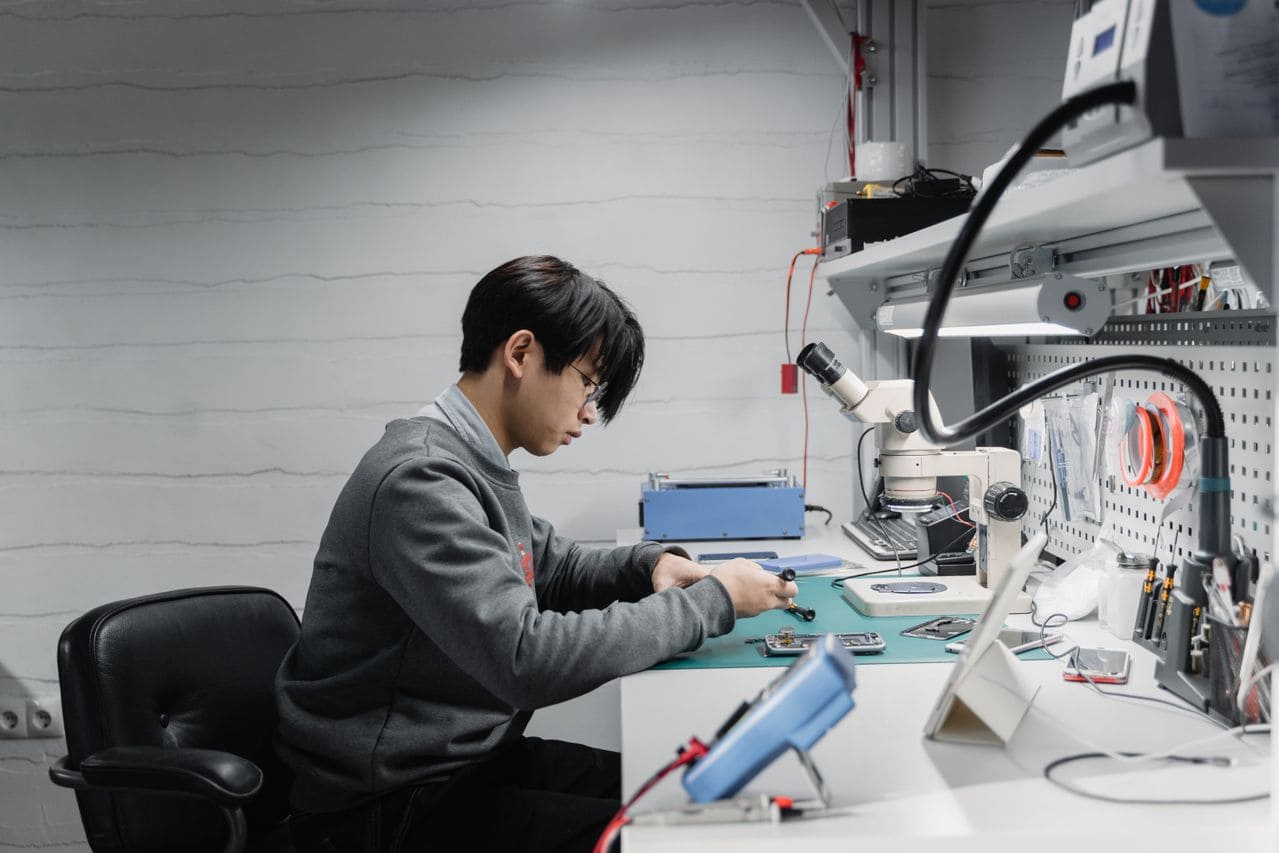
Advanced motherboard repair is different. Once you move into micro-soldering, IC work, short-circuit diagnosis and screen refurbishment, equipment such as a microscope, hot-air station, DC power supply, separator and OCA machines may become useful.
The Directorate General of Training (DGT) includes tools such as soldering irons, PCB holders, cutters, tweezers, digital multimeters, screwdrivers, mobile openers and related equipment in its Smartphone Technician Cum App Tester training setup.
This guide explains what each tool does, whether a beginner actually needs it, and approximately how much it can cost in India.
Important: Prices below are indicative online prices and can change. Brand, quality, specifications, GST, shipping, discounts and availability can affect the final price.
Quick Answer: Which Tools Are Needed for Mobile Repairing?
A beginner’s basic mobile repair setup can include:
- Precision screwdriver set
- Mobile opening tools
- Tweezers
- PCB holder
- Digital multimeter
- Soldering station or soldering iron
- Flux and solder wire
- Desoldering wick
- ESD mat and wrist strap
- Cleaning brush
- Isopropyl alcohol
- Magnifying lamp or microscope
For advanced motherboard repair, you may additionally need:
- Hot-air rework station
- DC power supply
- Stereo microscope
- Preheater
- Hot tweezers
- Reballing stencils
- PCB fixtures
- Thermal camera
- Programmer
- Ultrasonic cleaner
- Other model-specific diagnostic equipment
You do not need every machine on this list to start repairing phones.
The right equipment depends on the type of repair you want to perform.
Mobile Repairing Tools List with Prices
Here is a practical overview of commonly used mobile repair tools.
| Tool | Main purpose | Approx. price in India |
|---|---|---|
| Precision screwdriver set | Opening phones and removing screws | ₹300–₹2,000 |
| Mobile opening tools | Opening display/back covers | ₹100–₹1,000 |
| Tweezers | Handling small components | ₹100–₹1,500 |
| PCB holder | Holding motherboard securely | ₹200–₹1,500 |
| Digital multimeter | Measuring voltage, resistance and continuity | ₹500–₹3,500 |
| Soldering iron/station | Soldering components and wires | ₹1,000–₹12,000 |
| Flux | Improves soldering and component work | ₹100–₹800 |
| Solder wire | Making solder joints | ₹100–₹500 |
| Desoldering wick | Removing excess solder | ₹100–₹500 |
| ESD mat | Protecting electronics from static discharge | ₹500–₹2,000 |
| DC power supply | Board testing and power diagnosis | ₹3,000–₹15,000 |
| Hot-air rework station | Removing/reworking SMD components | ₹5,000–₹25,000 |
| Microscope | Inspecting and soldering tiny components | ₹15,000–₹50,000+ |
These ranges are broad because there are large differences between basic, professional and branded equipment. Current Indian listings, for example, show digital multimeters around ₹899, DC power supplies around ₹6,899–₹7,200 and trinocular microscopes around ₹18,499–₹25,999 depending on model.
1. Precision Screwdriver Set
Approximate price: ₹300–₹2,000
A precision screwdriver set is one of the first purchases a mobile technician should make.
Smartphones use very small screws and different screw-head designs. A good kit may contain:
- Phillips bits
- Torx bits
- Pentalobe bits
- Tri-point bits
- Flat bits
- Other small precision bits
A cheap screwdriver that doesn’t fit correctly can damage a screw head.
Should beginners buy one?
Yes.
This is a basic tool, not an advanced machine.
iFixit’s phone-repair resources also identify precision drivers, opening tools, tweezers and other hand tools as common equipment for smartphone repair.
2. Mobile Opening Tools
Approximate price: ₹100–₹1,000
These tools help technicians open phones without unnecessarily damaging the housing or internal components.
They can include:
- Plastic picks
- Spudgers
- Opening cards
- Suction cups
- Metal opening tools
- Pry tools
A plastic opening tool is particularly useful because it can reduce the chance of scratching or shorting components compared with using unsuitable metal objects.
3. Tweezers
Approximate price: ₹100–₹1,500
Tweezers are essential when working with tiny parts.
They are used for:
- Picking up screws
- Holding components
- Handling flex cables
- Positioning small electronic parts
- Soldering and rework
For motherboard work, good-quality fine-tip tweezers are worth buying.
4. PCB Holder
Approximate price: ₹200–₹1,500
A PCB holder keeps the motherboard stable while you inspect or solder it.
This becomes increasingly important when doing board-level repair.
Trying to hold a tiny motherboard with one hand while soldering with the other is a poor setup for precision work.
DGT’s official smartphone technician equipment list includes PCB holders/stands for mobile phones.
5. Digital Multimeter
Approximate price: ₹500–₹3,500
The multimeter is one of the most important diagnostic tools in mobile repair.
It can be used for measurements such as:
- Voltage
- Resistance
- Continuity
- Diode readings, depending on the meter
A multimeter helps you move from “replace parts until the phone works” to actual diagnosis.
For example, if a phone is not charging, a technician may need to determine whether the problem is related to the connector, battery, charging circuit or another part of the circuit.
Current Indian listings show basic mobile-repair multimeters below ₹1,000, while more advanced models cost considerably more.
Should a beginner buy a multimeter?
Absolutely.
Even if you initially perform only basic repairs, learning to use a multimeter is an important step toward professional repair work.
6. Soldering Iron or Soldering Station
Approximate price: ₹1,000–₹12,000+
A soldering tool is required for electrical and board-level work.
It can be used for:
- Wire repair
- Connector work
- Small component replacement
- Jumper work
- PCB repairs
- Micro-soldering, with an appropriate setup and skill
Basic soldering irons are inexpensive, while temperature-controlled professional stations can cost considerably more.
For example, current Indian listings include mobile-repair soldering stations from roughly ₹6,100 for a Baku station to more than ₹11,000 for a Hakko FX888D listing.
Soldering iron vs soldering station
A simple soldering iron may be enough for basic training.
A temperature-controlled soldering station is generally preferable for more precise electronics work because temperature control is important when working with delicate components.
7. Flux
Approximate price: ₹100–₹800
Flux helps solder flow properly and improves the quality of solder joints.
It is used extensively in electronics soldering and rework.
Do not choose flux solely because it is cheap. Quality and suitability matter, especially for fine board work.
8. Solder Wire
Approximate price: ₹100–₹500
Solder wire is used to create electrical and mechanical connections between components.
Different solder compositions and diameters are available.
For small smartphone boards, technicians often prefer relatively fine solder wire because the components and pads are tiny.
9. Desoldering Wick
Approximate price: ₹100–₹500
Desoldering wick, also called solder braid, absorbs excess solder.
It is useful when:
- Cleaning solder pads
- Removing excess solder
- Preparing a board for a replacement component
- Correcting solder bridges
It is inexpensive but extremely useful.
10. ESD Mat and Wrist Strap
Approximate combined price: ₹500–₹2,500
ESD means electrostatic discharge.
A static-electricity discharge that is harmless to a person can potentially damage sensitive electronics.
An ESD-safe workstation may include:
- ESD mat
- Grounding cord
- Wrist strap
- ESD-safe tweezers and tools
This is especially relevant when working directly with exposed circuit boards.
Don’t think of an ESD mat as an optional decoration for a professional-looking workbench. It is part of establishing a safer electronics-work environment.
11. DC Power Supply
Approximate price: ₹3,000–₹15,000
A DC power supply becomes especially useful for board-level troubleshooting.
It allows a technician to provide controlled DC power and observe electrical behaviour, depending on the model and repair procedure.
Current Indian listings include mobile-repair DC supplies around ₹6,899–₹9,299 for certain models.
Is a DC power supply necessary for beginners?
Not immediately.
If you’re learning:
- Screen replacement
- Battery replacement
- Speaker replacement
- Basic component replacement
you can start without an advanced bench power supply.
If your goal is motherboard diagnosis, however, it becomes much more useful.
12. Hot-Air Rework Station
Approximate price: ₹5,000–₹25,000
A hot-air station uses controlled heated air to work on SMD components.
It can be used for tasks involving:
- SMD components
- Connectors
- Shields
- ICs
- Board-level rework
Current Indian listings show examples ranging from around ₹10,500 for one YCS hot-air station to more advanced systems costing significantly more.
Should beginners buy a hot-air station?
If you’re only learning basic phone replacement work, no.
If you’re progressing toward motherboard repair, yes, eventually.
Using hot air without understanding temperature, airflow and the surrounding components can damage a board.
13. Microscope
Approximate price: ₹15,000–₹50,000+
A microscope becomes extremely valuable for advanced mobile motherboard repair.
Modern smartphone components can be too small to inspect accurately with the naked eye.
A microscope helps with:
- Inspecting solder joints
- Finding damaged components
- Micro-soldering
- Inspecting PCB tracks
- Connector repair
- IC work
Current Indian listings show trinocular stereo microscopes around ₹18,499 and ₹21,500, while higher-end models can cost considerably more.
Do beginners need a microscope?
For simple repairs, not necessarily.
For serious board-level repair, a proper microscope becomes one of the most valuable pieces of equipment on the bench.
Mobile Repairing Machines List with Prices
Tools and machines are not the same thing.
A screwdriver or multimeter is a tool. An OCA laminator or screen separator is a machine designed to perform a particular repair/refurbishment process.
Here are some common machines.
| Machine | Main use | Approx. price |
|---|---|---|
| Screen separator | Separating display from frame/glass | ₹2,000–₹10,000+ |
| Advanced separator | Flat/curved screen separation | ₹6,000–₹15,000+ |
| OCA laminator | Screen refurbishment | ₹40,000–₹55,000+ |
| Bubble remover | Removing bubbles after lamination | Varies |
| UV curing machine | Curing UV adhesive/film | ₹3,000–₹10,000 |
| Hot-air rework station | SMD/IC rework | ₹5,000–₹25,000 |
| DC power supply | Controlled board power/testing | ₹3,000–₹15,000 |
| Microscope | Board inspection/micro-soldering | ₹15,000–₹50,000+ |
| Reballing equipment | IC reballing | ₹2,000–₹15,000+ |
| Programmer | Memory/software-related board work | ₹5,000–₹60,000+ |
| Ultrasonic cleaner | Cleaning suitable PCBs/components | ₹2,000–₹15,000+ |
These are indicative categories rather than fixed prices. Specialized equipment can cost much more.
14. Screen Separator Machine
Approximate price: ₹2,000–₹10,000+
A separator heats the display assembly and helps separate components during screen repair or refurbishment.
Current listings include a Forward FW-361Max 7-in-1 separator at about ₹6,899.
The right separator depends on whether you are working with:
- Flat screens
- Curved screens
- OLED displays
- LCD displays
- Different phone sizes
Don’t assume one machine is suitable for every display type.
15. OCA Laminating Machine
Approximate price: ₹40,000–₹55,000+
OCA stands for Optically Clear Adhesive.
OCA lamination is associated with screen refurbishment, where the technician may separate damaged glass from an otherwise usable display assembly and bond a replacement layer.
This is advanced work, not something a beginner needs simply to replace a complete display assembly.
Current Indian listings include an all-in-one Forward QA-1Max around ₹45,999 and a Forward IOS automatic OCA laminator around ₹54,999.
Another current listing for a REFOX FM30 3-in-1 machine shows ₹44,500 and describes its functions as separation, lamination and debubbling for compatible flat screens.
16. UV Curing Machine
Approximate price: ₹3,000–₹10,000
UV curing equipment can be used with suitable UV adhesives and films.
One current Indian listing for the Sunshine S-918B Plus UV curing/vacuum/filming machine is ₹3,499.
This type of machine is more relevant to technicians performing specialized screen-related work than to someone starting with basic phone repair.
17. Reballing Stencils and Platforms
Approximate price: ₹500–₹6,000+ depending on type
Reballing involves removing and replacing solder balls associated with suitable BGA-type components.
Different stencils can be designed for different:
- CPUs
- Memory chips
- IC packages
- Manufacturers
- Phone models
A reballing platform helps hold and align components or stencils.
Current Indian listings include reballing platforms around a few thousand rupees and model-specific stencils at lower prices.
This is advanced motherboard work and should not be the first skill a beginner attempts.
18. Programmer
Approximate price: ₹5,000–₹60,000+
Programmers are specialized devices used for certain memory, firmware, diagnostic or board-level tasks.
The exact function depends heavily on the programmer.
For example, an F64 Ultra Box listing currently shows ₹58,999 and describes support for eMMC/UFS-related professional work.
A beginner should not buy a programmer simply because it appears on a mobile-repair tools list.
First determine which repairs you intend to perform and whether that particular programmer supports the devices and procedures you actually handle.
19. Ultrasonic Cleaner
Approximate price: ₹2,000–₹15,000+
An ultrasonic cleaner uses ultrasonic energy in a cleaning solution to clean suitable components or PCBs.
It may be useful for certain contamination or liquid-damage-related workflows.
However, ultrasonic cleaning is not a magic solution for every water-damaged phone.
The correct cleaning process depends on the board, components, contamination and technician’s knowledge.
20. Thermal Camera
Approximate price: ₹8,000–₹50,000+
A thermal camera can help identify unusual heat patterns on a circuit board.
This can be useful during some forms of:
- Short-circuit diagnosis
- Power troubleshooting
- Component fault finding
But a thermal camera is an advanced diagnostic aid, not a replacement for a multimeter and electronics knowledge.
Current specialist listings show mobile-repair thermal diagnostic devices in the several-thousand-rupee range, with more advanced systems costing substantially more.
Beginner Mobile Repair Tool Kit: What Should You Buy First?
If you are just starting, don’t buy everything.
A sensible starter setup could include:
Essential
- Precision screwdriver set
- Mobile opening tools
- Tweezers
- PCB holder
- Digital multimeter
- Soldering station
- Flux
- Solder wire
- Desoldering wick
- ESD mat
- Cleaning brush
- Isopropyl alcohol
Here is a good guide to buy the best digital multimeter for mobile repairing. Do read it before buying a multimeter.
Approximate beginner budget
A practical beginner setup can often be assembled for roughly ₹5,000–₹15,000, depending heavily on tool quality and how much equipment you already have.
Current Indian tool listings support this broad range: for example, a precision screwdriver set may be listed below ₹1,000, an entry-level multimeter below ₹1,000, and a basic soldering station several thousand rupees higher.
You do not need an expensive microscope or OCA machine at this stage.
Professional Mobile Repair Bench: What Do You Need?
If your goal is advanced motherboard repair, a more complete setup might include:
- Professional soldering station
- Hot-air rework station
- Stereo microscope
- DC power supply
- Multimeter
- PCB holders
- ESD workstation
- Hot tweezers
- Preheater
- Reballing tools
- Stencils
- Thermal camera
- Diagnostic/programming equipment
- Fume extraction/ventilation
- Good lighting
- Component storage
A professional board-level setup can easily reach ₹50,000–₹1,00,000 or more, particularly once a good microscope, rework equipment and specialized diagnostic tools are included. Current Indian specialist-tool listings illustrate how quickly costs rise: microscopes alone can exceed ₹20,000, while specialized OCA machines and programmers can cost ₹40,000–₹60,000 or more.Here is a more detailes guide and list of advanced eMMC mobile phone repair tools you need to buy for a professional advanced level repair setup.
Basic vs Professional Setup
| Setup | Approximate budget | Suitable for |
|---|---|---|
| Very basic toolkit | ₹2,000–₹5,000 | Learning/opening phones |
| Beginner repair bench | ₹5,000–₹15,000 | Basic repairs |
| Intermediate bench | ₹15,000–₹40,000 | Hardware + some board work |
| Advanced board-repair setup | ₹40,000–₹1 lakh+ | Micro-soldering and diagnostics |
| Screen refurbishment setup | ₹50,000+ | OCA/display refurbishment |
| Highly specialized workshop | ₹1 lakh+ | Advanced board + screen work |
These are planning ranges, not official price bands.
Which Tools Are Actually Necessary?
One of the biggest mistakes new technicians make is confusing “available tools” with “necessary tools.”
You don’t need:
- OCA laminator
- Laser machine
- Expensive programmer
- High-end microscope
- Thermal camera
to start replacing smartphone screens.
You need those types of equipment only when the repairs you perform justify the investment.
For basic repair
Prioritize:
Screwdrivers → opening tools → tweezers → multimeter → soldering station
For motherboard repair
Add:
Microscope → hot air → DC power supply → better diagnostic equipment
For screen refurbishment
Add:
Separator → OCA equipment → laminator → bubble-removal equipment → related fixtures
This staged approach can save a beginner a considerable amount of money. If you want to learn mobile repairing in mumbai, here is the list of best mobile repairing course institutes in mumbai for your convenience.
How to Choose Good Mobile Repair Tools
Price should not be your only criterion.
1. Buy according to your skill level
A ₹50,000 machine is not automatically useful to a beginner.
2. Check specifications
For powered equipment, look at:
- Voltage
- Current
- Temperature control
- Power rating
- Protection features
- Nozzle/handle compatibility
- Replacement-part availability
3. Consider spare parts and service
A machine is less useful if replacement heating elements, tips or other consumables are impossible to obtain.
4. Don’t buy everything as a kit
Some large “professional tool kits” contain equipment you may rarely use.
Build your bench around the repairs you actually perform.
5. Buy safety equipment too
A repair bench should not consist only of tools that make money.
It should also include equipment that helps you work safely.
Safety Equipment Is Part of Your Tool List
Mobile repair involves:
- Heat
- Electricity
- Soldering
- Flux
- Adhesives
- Cleaning chemicals
- Sharp tools
- Pressurized equipment in some machines
Good ventilation is particularly important when soldering. NIOSH guidance on soldering and brazing discusses ventilation, protective measures and worksite controls, while OSHA guidance also discusses local exhaust ventilation for work that produces fumes.
A professional bench should therefore consider:
- Fume extraction or suitable local ventilation
- Eye protection where appropriate
- ESD precautions
- Heat-resistant work surfaces
- Proper chemical storage
- Good lighting
- Fire-safety measures
- Safe electrical connections
Never touch hot soldering tips or recently heated components with bare fingers.
Common Mistakes When Buying Mobile Repair Equipment
Buying expensive equipment before learning the basics
A beginner may buy a microscope, hot-air station and DC supply but still not know how to diagnose a charging fault.
Training comes first.
Choosing the cheapest soldering station
Very cheap equipment may provide poor temperature stability or inconsistent performance.
For precision electronics work, reliability matters.
Buying a machine without understanding its purpose
Don’t buy an OCA laminator just because someone calls it a “professional mobile repairing machine.”
First understand what OCA refurbishment involves.
Assuming one machine works on every phone
Phone displays differ significantly.
Always check machine compatibility and working dimensions.
Ignoring consumables
Machines also require consumables such as:
- Flux
- Solder
- Solder wick
- Adhesives
- OCA film
- Cleaning materials
- Blades
- Protective films
- Stencils
Your real operating cost is more than the machine’s purchase price.
Frequently Asked Questions
What are the basic tools required for mobile repairing?
A beginner should start with a precision screwdriver set, opening tools, tweezers, PCB holder, digital multimeter, soldering equipment, flux, solder, desoldering wick and an ESD-safe work surface.
How much does a mobile repairing tool kit cost in India?
A basic setup can be assembled for roughly ₹5,000–₹15,000, while advanced professional benches can cost ₹50,000–₹1 lakh or more. The actual amount depends on the quality and number of tools purchased.
Which machine is most important for mobile repairing?
There is no single most important machine. For basic repair, a soldering station and multimeter are more useful than expensive refurbishment equipment. For motherboard work, a microscope, hot-air station and DC power supply become much more important.
Is a microscope necessary for mobile repairing?
Not for every repair. It is particularly useful for motherboard work and micro-soldering, where components and solder joints are extremely small.
Is a hot-air station necessary for beginners?
No. Beginners doing basic replacement work can start without one. It becomes more useful when learning SMD and board-level repair.
How much does a mobile repairing machine cost?
It depends on the machine. Basic separators may cost several thousand rupees, while professional OCA laminators can cost ₹40,000–₹55,000 or more. Specialized programmers and other equipment can cost considerably more.
What equipment is needed for motherboard repair?
A serious board-repair bench generally benefits from a microscope, temperature-controlled soldering station, hot-air rework station, digital multimeter, DC power supply, PCB holder and appropriate diagnostic/repair accessories.
Do I need an OCA machine to repair mobile screens?
No. You don’t need an OCA laminator for ordinary complete display replacement. OCA equipment is mainly relevant to specialized screen refurbishment and glass/OCA replacement workflows.
Conclusion
You don’t need to spend a fortune to start learning mobile repairing.
For a beginner, concentrate on the fundamentals:
Precision tools + multimeter + soldering equipment + safe workspace + practical training.
Once you become comfortable with basic repairs, you can gradually add:
Hot air → microscope → DC power supply → board-level tools → specialized machines.
If your business later expands into screen refurbishment, you can consider a separator and OCA laminating equipment. If you specialize in motherboard repair, investment in microscopy, rework and diagnostic equipment becomes more relevant.
The smartest way to build a repair bench is therefore not to ask:
“What is the most expensive mobile repairing machine I can buy?”
Instead ask:
“What repair problem will this tool help me solve, and do I have the skills to use it properly?”
That approach will help you build a capable mobile repair workstation without wasting money on equipment you don’t yet need.